

Key takeaways
Best fit
Targeted SDR and AE teams that value fast contact discovery and browser prospecting.
Core strength
Contact and company data
Main tradeoff
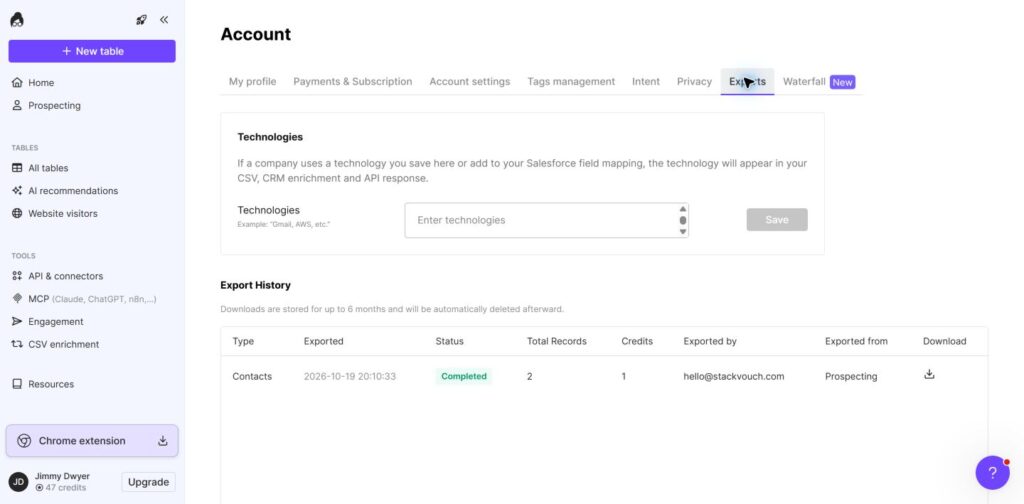
The two-record CSV export added one credit beyond the two email reveals in our Free-plan workflow.
Paid pricing
Paid packages from $49.90/month, Starter with one seat; checked November 6, 2026
Hands-on testing
Free plan · Workflow test completed
Sample / task scope: One fixed search; ten results reviewed; Free plan.
October 19–20 Free-plan workflow: first ten filtered results, two email reveals, eight access gates, two-record CSV inspection, exact repeated table addition and one persisted unsent email step. No phone reveal, mailbox connection, campaign activation or delivery test.
| Test observation | Buying implication |
|---|---|
| Fixed first ten: two email values retrieved, eight paid-plan gates | Free-plan access limited this sample; this is not an accuracy or US-wide coverage rate |
| Two records saved; an exact repeat left two rows | The existing-table handoff worked; Prospecting new-table creation had failed |
| Two-record CSV: 56 unique fields, matched name/company and name/email pairs | File consistency checked; A+ labels are supplier classifications, phones stayed masked |
| Two reveal credits plus one export credit; three total | Include export events in the workflow budget; this is one measured email-first workflow |
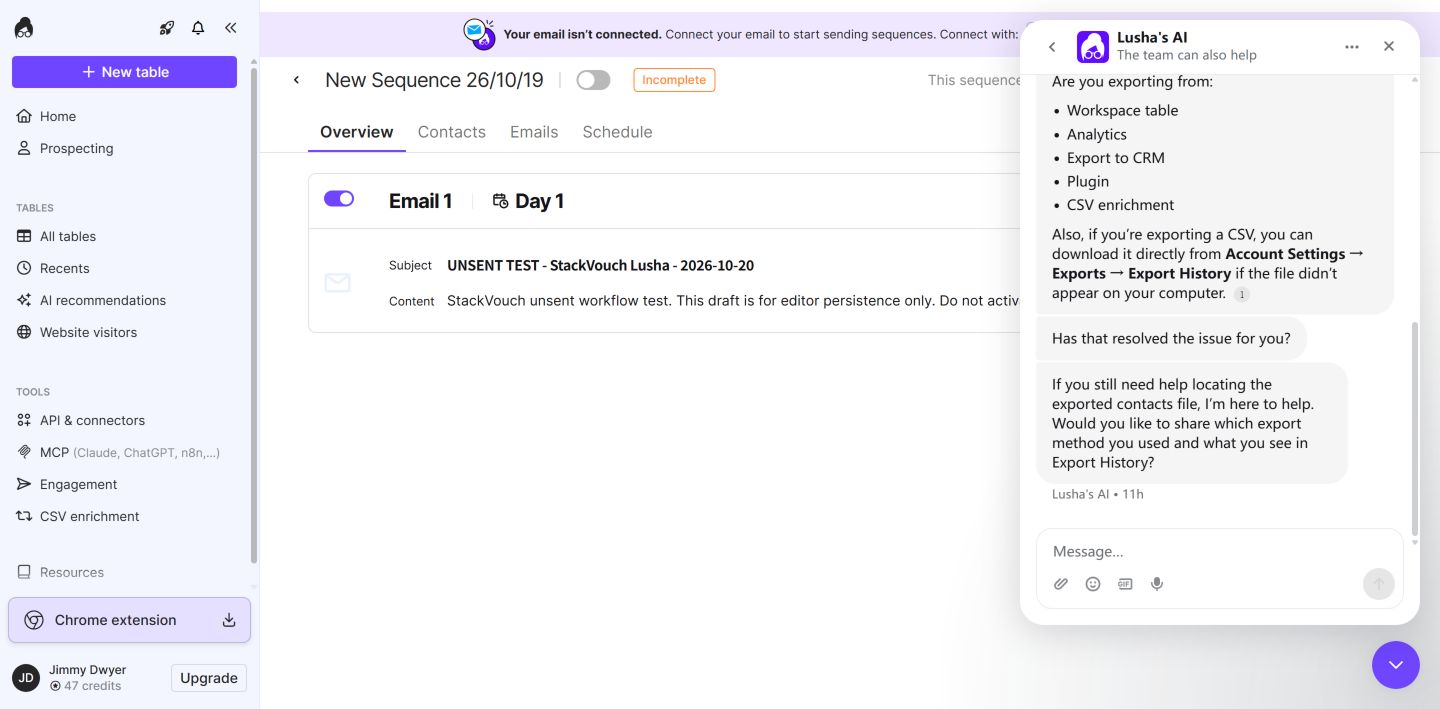
| October 20: saved email subject and body persisted after reload | Basic draft preparation worked after an initial loading problem; sequence remained unlaunched |
| No mailbox connection, contact enrollment or email send | Delivery, timing, personalization and independent accuracy remain outside the test |
What we did not test
- Free plan, October 19–20, 2026: no phone retrieval, phone-quality test, paid-tier test or independent data-accuracy benchmark.
- No connected mailbox, contact enrollment, outbound email, timed execution, CRM transfer or API request was tested.
These are limits of this assessment, not findings that the product cannot perform the tasks.
Lusha product tour
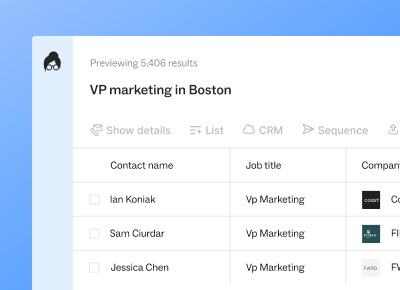
Official product visuals, not evidence of StackVouch hands-on testing.
Pricing
November 6, 2026: the default USD monthly package configurations display Starter $49.90 with one seat, Pro $69.90 with two and Premium $399.90 with five; Free lists 40 credits/month. These are package prices, not universal per-seat rates. See the pricing guide for allowances, annual displays and budget examples.
Free lists 40 credits per month and one seat. The unchanged monthly configurations checked November 6, 2026 were Starter $49.90 (one seat), Pro $69.90 (two seats) and Premium $399.90 (five seats). Scale is custom. Lusha pricing: package allowances, credit costs and annual terms →
How Lusha credits change the real cost
Our measured email-first workflow used three credits: two for Show emails and one for a two-record CSV export. The export dialog quoted one credit per 25 contacts, and Export History confirmed a one-credit charge. Table transfer and an exact repeated addition added no observed charge.
Continue reading
The earlier October 13 documentation check distinguished Workspace/Extension email and phone units, API request charges and export events. We did not re-test phones, API, credit expiry or CRM export in this run. Keep those dated documentation rules separate from the three measured credits; confirm endpoint-specific units before budgeting an API workflow.
Is the Free plan useful?
The October 19 price card listed Free at $0, 40 credits per month and one seat, without a credit-card requirement. Our fixed sample exposed two email values and eight paid-plan gates. Free can demonstrate the workflow, but unused credits do not guarantee access to every target.
What our two-record workflow cost
Measured Free-plan credit usage on October 19, 2026; this is a workflow cost observation, not a paid subscription quote.
| Operation | Observed credits | Result |
|---|---|---|
| Show emails for two contacts | 2 | Two email values |
| Check eight gated results | 0 additional | Paid access required |
| Export two contacts | 1 | Completed job; two-row CSV inspected |
| Table transfer and exact repeat | 0 additional | Table stayed at two rows |
Three credits total. The export dialog quoted one credit per 25 contacts. This measured workflow does not establish a dollar cost per usable contact or independent accuracy result.
Official pricing source · Rules checked 2026-10-19
The buying decision
Use the task checks below to distinguish tested handoffs from features that still need a demonstration on your intended plan.
| Task | What to validate | What we tested |
|---|---|---|
| Contact search and access | Try your target geography and retain unavailable or gated records. | First ten filtered results retained: two email values, eight paid-plan gates. |
| Named table and duplicates | Reopen the saved table; repeat an exact addition and separately assess fuzzy/team-wide cases. | Two rows persisted; exact repeat left two rows. One new-table route returned an error. |
| CSV handoff | Check row widths, field names, email pairings, status labels and export charges. | Two rows, 56 unique fields and matched pairs; one export credit. Phones remained masked. |
| Engage draft | Confirm saved content, timing, missing-field behavior and mailbox entitlement separately. | One subject/body persisted on October 20; incomplete and unlaunched. No timing or delivery test. |
| Phone, API and CRM | Confirm plan, units, endpoints, overwrites and cleanup using an authorized sandbox. | Not executed; existing documentation remains dated research evidence. |
Data quality: what the evidence says
Lusha currently publishes a 98% email headline metric and 86% phone accuracy. The same Lusha data page calls the 98% figure 'email accuracy' in one place and 'email deliverability' in another. StackVouch therefore treats 98% as a vendor-published headline metric rather than silently equating accuracy with deliverability.
Lusha publishes two materially different July 2026 test sets. In a 322-contact US segmented test, Lusha reports a usable work email for 322/322 contacts and 97.5% overall mobile hit. In a separate 4,996-LinkedIn-URL comparison, Lusha reports 55% work-email hit, 54% mobile hit, 68% email-or-phone hit and 40% email-and-phone hit. Lusha is the publisher and a product in the comparison, so StackVouch treats these as vendor evidence rather than independent benchmarks. The different results illustrate why sample construction matters: hit rate is not automatically deliverability, long-term correctness or universal accuracy.
The Free-plan test used ten fixed results and retrieved two email values; eight records were paid-plan gated. Neither gated access nor a displayed email is an accuracy measurement. The inspected CSV preserved the recorded name/company and name/email pairings and labeled both work emails A+. These are supplier classifications. We did not independently verify current roles, employer association, address ownership or deliverability. Vendor benchmarks below retain their own sample and publisher attribution.
How to validate Lusha on your own ICP
Define the target segment, required channels, usable-record threshold, maximum workflow budget and cleanup time before comparing tools. Use the same reference list, count all submitted targets, and keep gated, missing and unverified outcomes visible.
For each result, independently check current employer and role, required channel, reveal/export charges and the chosen CRM or sender handoff.
Continue reading
Record which claims came from documentation and which you observed. Our two retrieved email values and A+ supplier labels are not independent verification.
Retain a candidate only when its required handoffs meet your stated thresholds. Record rejected candidates, missing quote inputs and the condition for purchase; unresolved charges are not zero.
Integrations
Choose the handoff before the plan: extension to CRM, Engage to a connected mailbox, or API to your own workflow.
The October 13 documentation check found API access described on every plan in both the FAQ and technical credit guide. Rate limits, permissions and endpoint availability still require account-level confirmation.
Test duplicates, changed jobs and retries before assuming a connector removes manual work. We did not execute a CRM or API integration in this test.
Documentation checked October 13: Lusha FAQ and API credit guide. These document checks are separate from our October 19–20 workflow test.
Pros and cons
Pros
- Two email values were retrieved and preserved with their name pairings in a checked CSV.
- A named two-record table survived reopening; one exact repeated addition created no extra rows.
- One unsent email subject and body persisted after reload on the October 20 re-test.
- The pricing page exposed USD package prices, credit allocations and included seats.
Cons
- The two-record CSV export added one credit beyond the two email reveals in our Free-plan workflow.
- Prospecting new-table creation returned an error in the tested account; a separate table-creation route worked.
- The body editor initially stayed loading; a later re-test worked without diagnosing the cause.
Methodology
- Hands-on: Jimmy Dwyer opened a self-service Free account on October 19; fixed first ten filtered results, no replacements and no sends.
- Measured: two email values, eight paid-plan gates, three credits, table persistence and one exact repeated addition.
- October 20: inspected the downloaded two-row, 56-field CSV; saved and reloaded one unsent email step.
- Pricing: USD monthly/yearly selectors captured October 19; seats and credit slider left unchanged; no checkout.
- Other capability and vendor-benchmark statements retain their earlier source dates; they are not new test results.
- Limits: no independent contact-quality or delivery check, phone reveal, extension, CRM/API execution, paid upgrade or connected mailbox.
Final verdict
Our Free-plan run supports Lusha as a candidate for a small email-first discovery-to-table-to-CSV workflow, with a saved unsent email step. The main constraint was access: eight of ten fixed results were gated, and exporting the two retrieved records added a credit. Test your own target segment and total reveal/handoff cost before buying. This report does not establish contact accuracy, paid-tier coverage or sending performance.
Best for
- Email-first teams willing to check Free-plan access against their actual target locations.
- Buyers who want to inspect a saved table and CSV before deciding whether to upgrade.
- Teams evaluating basic unsent draft preparation alongside an existing sender or CRM.
Not ideal for
- Buyers treating free credits as guaranteed access to every US contact.
- Teams requiring independent accuracy, phone coverage or deliverability proof from this small test.
- Buyers relying on paid-tier, API, CRM or live-sequence behavior without a separate demonstration.
We may earn a commission if you buy through links on this page. How our links work.
If broader prospecting-to-engagement tooling is the main requirement, compare Lusha with Apollo →
Continue your evaluation
Compare the closest options, then explore costs and switching trade-offs.
- Apollo vs Lusha 2026: Pricing, Credits & Which to PickApollo Basic displays $49/seat/month billed annually; Lusha Starter $49.90/package monthly. Compare workflow scope, credits and our different October…
- Lusha vs Cognism 2026: Self-Serve Credits or a Custom Quote?Lusha Starter displays $49.90/month for one included seat; Cognism is quote-led. Compare contact-reveal entry, phone workflow requirements and…
- Lusha vs RocketReach 2026: Credits, Lookup & Best FitLusha Starter displays $49.90/month for one seat; RocketReach’s current numeric quote is unverified here. Compare lookup, CSV costs…
- Best B2B Contact Databases for Small SDR Teams (2026)Compare B2B contact databases for small SDR teams by data-plus-outreach fit, email and phone credit rules, export limits…
Evidence
Sources & verification
Key product facts on this page were checked against the sources below. Pricing, plan names and feature entitlements can change.
- 1lusha.com — Faq (opens in a new tab)
- 2lusha.com — Pricing (opens in a new tab)
- 3lusha.com — Best B2b Contact Database (opens in a new tab)
- 4docs.lusha.com — How Credits Work In Lusha (opens in a new tab)
- 5docs.lusha.com — What Is Lusha Engage (opens in a new tab)
- 6docs.lusha.com — All There Is To Know About Lushas Api (opens in a new tab)
- 7docs.lusha.com — How Credits Are Counted (opens in a new tab)
- 8lusha.com — Data (opens in a new tab)
- 9lusha.com — Best Sales Intelligence Software Us Data Accuracy (opens in a new tab)
- 10lusha.com — Lusha Vs Zoominfo Hit Rate Native Data Vs A 25 Vendor Waterfall (opens in a new tab)
Frequently asked questions
Is Lusha worth it?
Consider it when contact reveals, saved-table preparation and a small CSV handoff match your task. The Free test does not establish paid-tier coverage, phone accuracy or sending performance.
How much does Lusha cost?
With the credit slider and seat inputs unchanged, monthly packages displayed Starter $49.90 (one seat), Pro $69.90 (two seats) and Premium $399.90 (five seats). Scale is custom. These are package prices, not three per-seat rates.
Does Lusha have a free plan?
Yes. The public Free card checked November 6 lists $0, 40 credits per month and one included seat, with no credit card required. A free allowance is not a promise of a particular number of usable contacts.
What did StackVouch test?
Our October 19–20 Free workflow used ten fixed results, two email values, a checked two-record CSV and a persisted unsent email step. No independent accuracy test, paid plan, phone reveal or CRM/API handoff was completed.