
Purpose and test conditions
Could we create a prospect list, import one authorized profile and prepare an unsent LinkedIn sequence in Waalaxy? Jimmy Dwyer opened a self-service trial on October 18, 2026. The account displayed Advanced, 7 days remaining and 25 credits. We used Jimmy’s own LinkedIn profile for this test.
Waalaxy displayed Jimmy Dwyer as the LinkedIn identity and linked to his real, tester-owned profile. We did not connect a new account, audit the existing session permissions or establish whether it was dedicated to testing. The campaign stayed inactive throughout: initial and final dashboards showed zero active campaigns, and the final queue and sent-action counters were zero. No invitation, message, email, visit or follow was sent.
What we tested
We created StackVouch Trial 2026-10-18 - Own Profile, then chose the single LinkedIn profile import route. Other offered sources included CSV, LinkedIn search and network, engagement signals, Sales Navigator and Recruiter. We subsequently completed a one-record CSV import; the other sources were not executed.
The empty URL form allowed a submit attempt and then displayed a valid-profile warning. We entered Jimmy’s own profile URL. The resulting widget recorded one scanned, zero successful, zero duplicates and zero false positives, while its heading still described an import in progress. On a later check after refreshing the session, the list still contained zero records. We did not establish whether the request completed, why it had zero successes or whether using the account holder’s own profile affected the result.
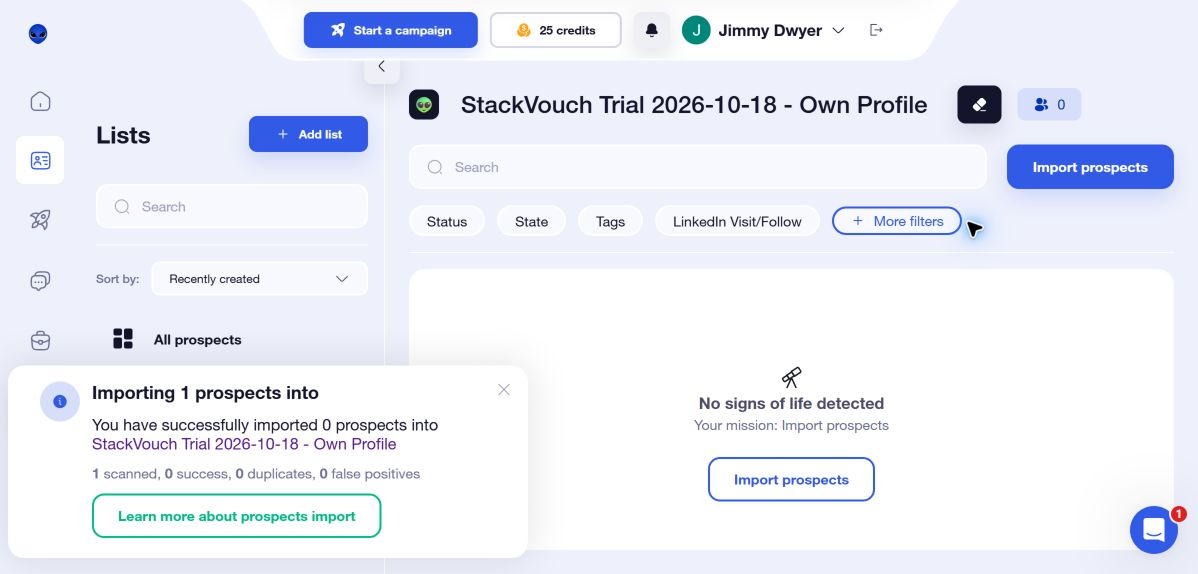
Direct-profile retry, October 19: We submitted the same tester-owned URL once more into a new empty list, with Move duplicates to import list disabled. The receipt again showed one scanned, zero successes, zero duplicates and zero false positives, while its heading still said Importing. Refreshing left the new list empty. The original CSV-imported record already existed in a separate list; this was not a clean-account reproduction, and the receipt did not diagnose that difference. No campaign was activated or outreach sent. The retry reproduces zero observed successes, not a confirmed terminal failure or its cause.
CSV mapping, import and download
On October 19 we submitted a CSV containing only Jimmy’s authorized profile URL and manually supplied first/last name. Waalaxy detected one prospect, recognized the LinkedIn URL automatically and mapped the two name columns. Those name values came from the CSV, not an independent data-discovery result.
The final import screen defaulted to moving duplicate prospects into the target list. We disabled that option and kept overwriting existing data disabled. The receipt reached 100% completed, with one success and zero duplicates or false positives. Reloading the named list showed one Jimmy Dwyer record and an October 19 import date. Job and company fields were blank in the observed row; we did not run the email finder.
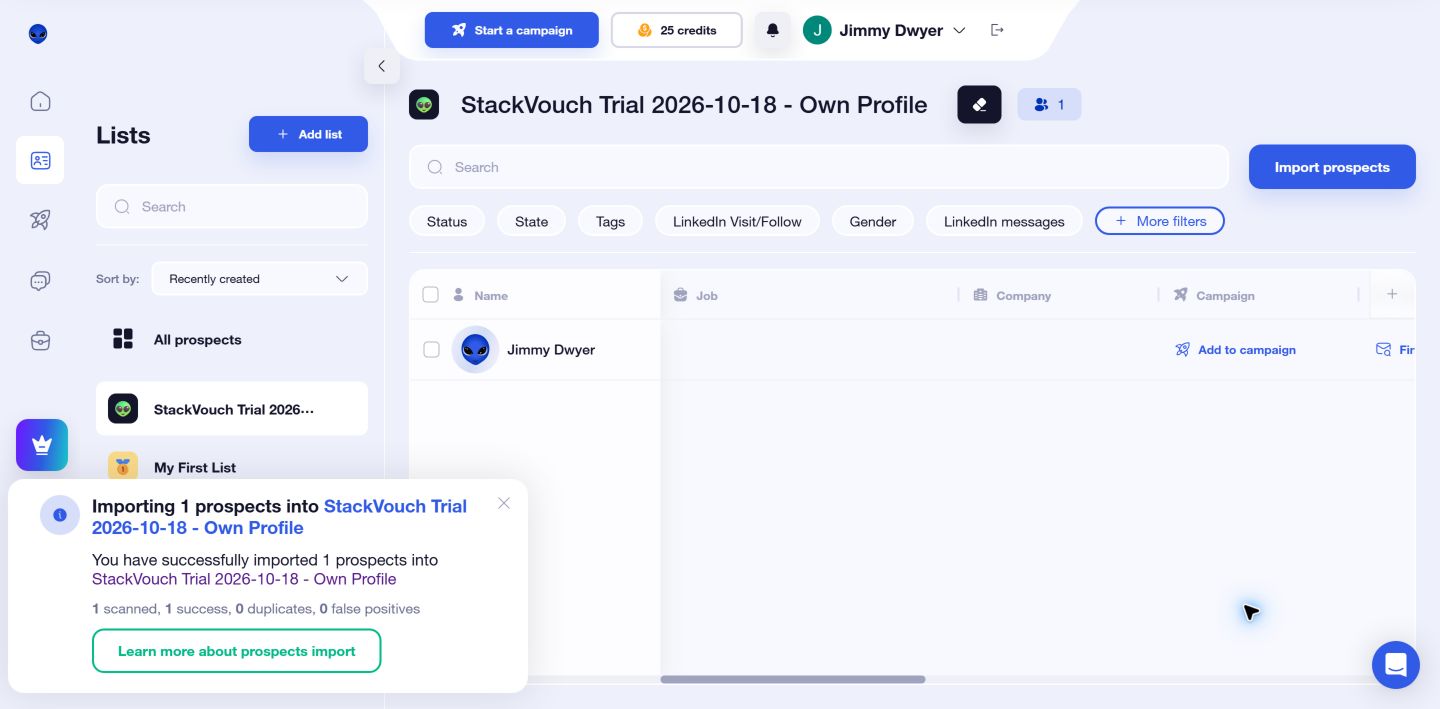
We selected only that record and used Export → Download CSV file. The downloaded Jimmy_Dwyer.csv was 737 B. File inspection confirmed it had one data record, 40 unique column names and 40 values in the record, in UTF-8 without a BOM. First name, last name and LinkedIn URL exactly matched our input. The list name was preserved and the import date was October 19.
Email, phone, job, company and country fields were blank. This was a successful import/export of supplied values, not a contact-discovery or enrichment result. The record’s message/email sent and reply flags were No, and its CRM status was not_synced.
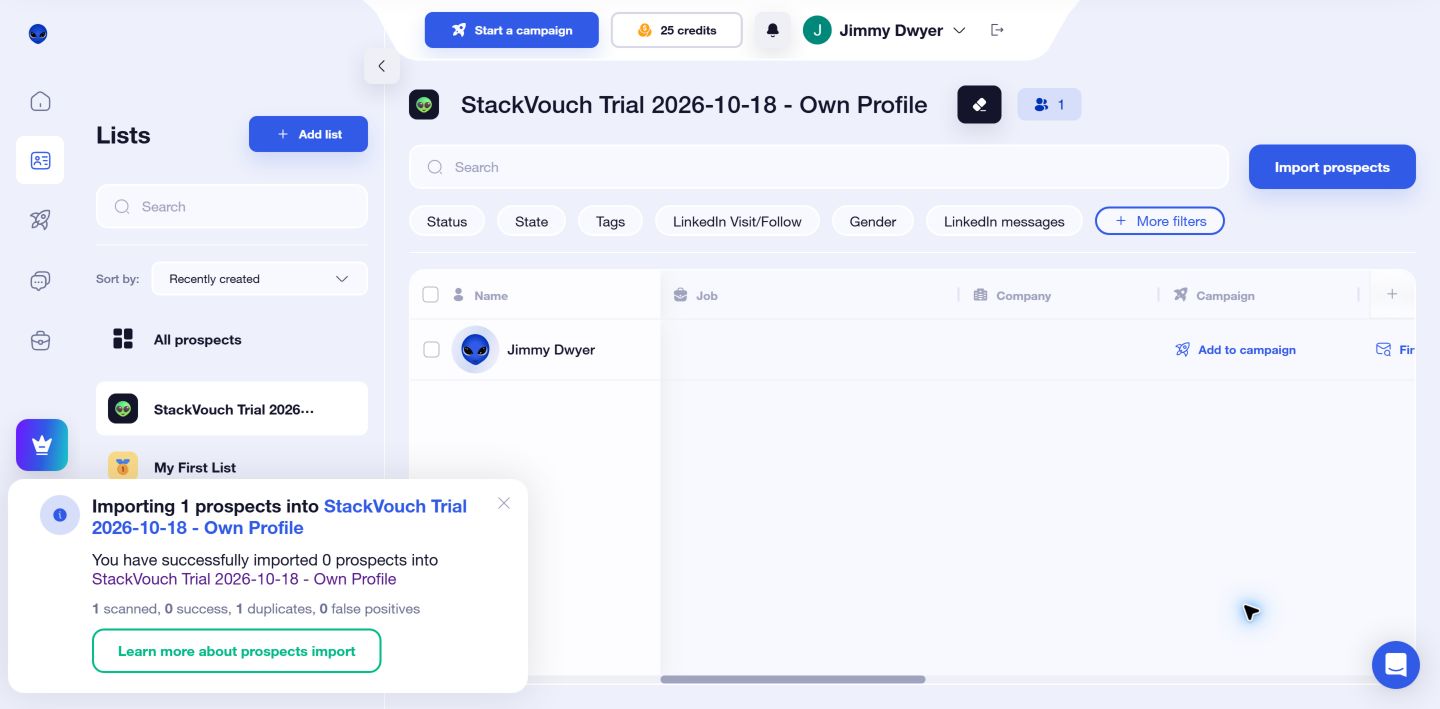
We then imported the identical CSV once more, keeping duplicate movement and overwriting off. The receipt showed one scanned, zero successes, one duplicate and zero false positives. Its heading still said Importing and did not show a 100% completion label, but reloading the list confirmed it still contained exactly one record. This checks one exact repeat in the same list; it does not establish fuzzy matching or team-wide duplicate behavior.
Sequence configuration and saved draft
The campaign catalog offered LinkedIn invitation and message templates. Email and multichannel examples carried Business labels and preview controls in this Advanced account. That is the account state we observed; we did not purchase or test another tier.
We selected Invitation + 2 Messages. Its description said messages follow an accepted invitation. The preview showed no invitation note, then delays of one day and five days between the message steps. Those are displayed settings, not observed timed execution or proof that replies stop future steps.
Our initial October 18 setup had not produced a stored campaign: refreshing showed Draft 0. On October 19 we configured StackVouch Trial - DRAFT ONLY - 2026-10-19, using Add later to continue with no enrolled prospects. We kept the invitation without a note, changed the accepted-invitation delay from one to two days, and changed the second delay from five to three days.
The invitation-note step displayed a notice referring to LinkedIn Premium or Sales Navigator and a Check my LinkedIn subscription control. We did not run that check, enter an invitation note or establish its entitlement requirements through a completed test.
We configured two explicitly unsent test messages. The variable menu offered first name, last name and company. We inserted first-name and company variables using the menu, then entered a company fallback of your company. The fallback required its own confirmation button: clicking away from the field without confirming did not retain the attempted value.
Preview displayed the built-in James / Waalaxy example. It was useful for seeing the message layout, but it did not preview Jimmy’s imported record or demonstrate substitution for a real missing company field.
The final check showed two completed messages and said prospects still needed to be selected. It also stated that responding prospects automatically exit the campaign; we did not test an actual reply. Jimmy manually clicked Save Changes. After reload, the campaign list showed Draft 1; reopening it confirmed both message bodies, the company fallback and the two-day / three-day delays were retained. No prospect was enrolled and Launch my campaign was not clicked.
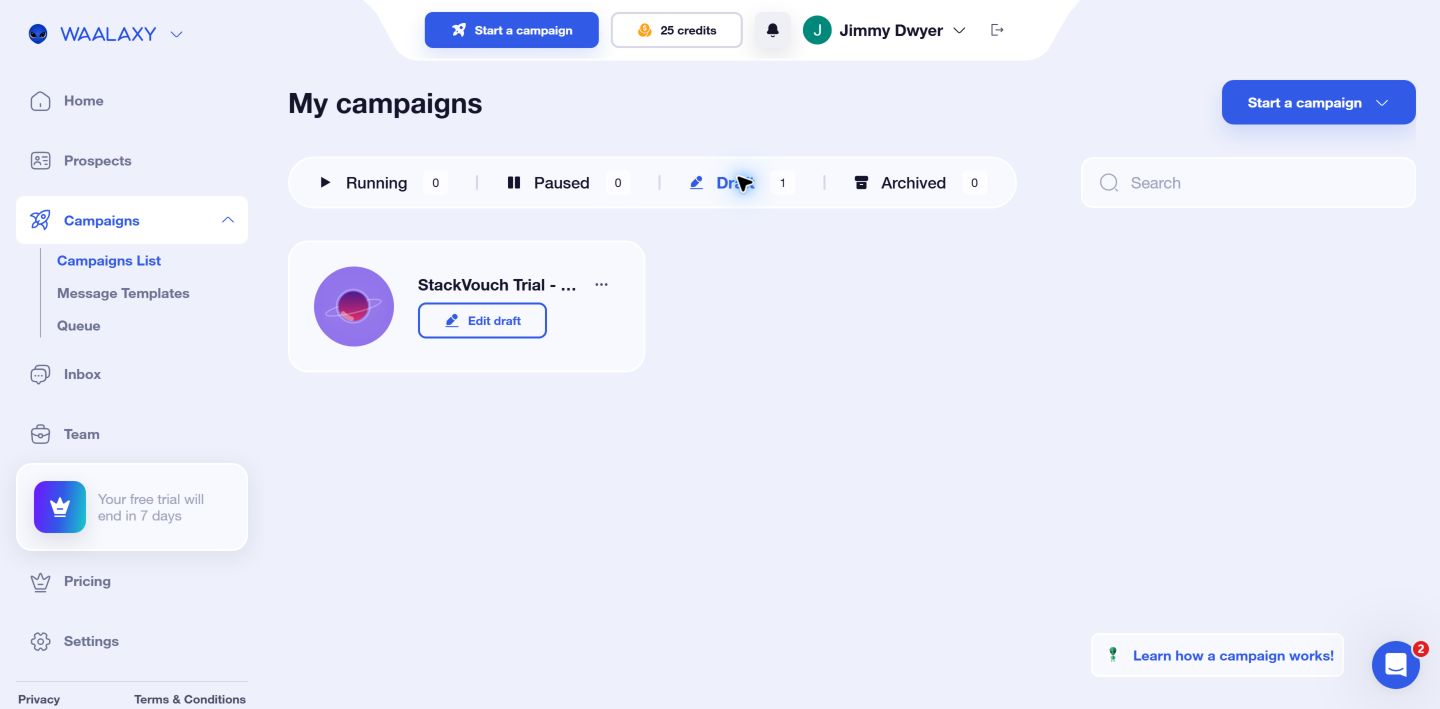
Reopening the draft also displayed an optional CRM sync on reply step. We inspected its provider choices without connecting a service or executing a sync. The final dashboard showed Inactive, zero active campaigns, zero queued actions and zero invitations, messages, visits or follows sent. The queue page separately showed LinkedIn 0, Email 0 and no actions. The displayed credit balance remained 25; we did not audit credit accounting.
The selector stated that prospects must not already be in another campaign or connected with the current account. A vendor-provided sample list contained 27 records; we left it unused. These records are not a StackVouch import sample.
Trial and purchase context
The public pricing page, retrieved October 18, advertised a 14-day trial. Our account displayed 7 days remaining. We have not established why those surfaces differed or which offer terms applied to this account. The remaining-time label must not be generalized into a universal seven-day trial claim.
On October 19 we explicitly selected Monthly and Yearly on the account pricing page and the fully loaded public pricing page in the same Chrome session. Both displayed:
| Plan | Monthly | Per month with Yearly selected |
|---|---|---|
| Pro | $19 | $16 |
| Advanced | $39 | $32 |
| Business | $69 | $55 |
The selector advertised 20% yearly savings. Using the rounded displayed monthly amounts, the reductions are about 15.8% for Pro (19 to 16), 17.9% for Advanced (39 to 32) and 20.3% for Business (69 to 55). These display-based calculations do not establish the actual annual discount or invoice. The public FAQ still mentioned quarterly billing and up to 50% annual savings with upfront payment. Those statements do not match the current selector, so confirm the applicable offer and total before purchase. We did not enter checkout, verify taxes or renewal charges, or calculate a confirmed annual invoice from the rounded monthly display. Trial template availability does not establish the entitlement of another paid tier.
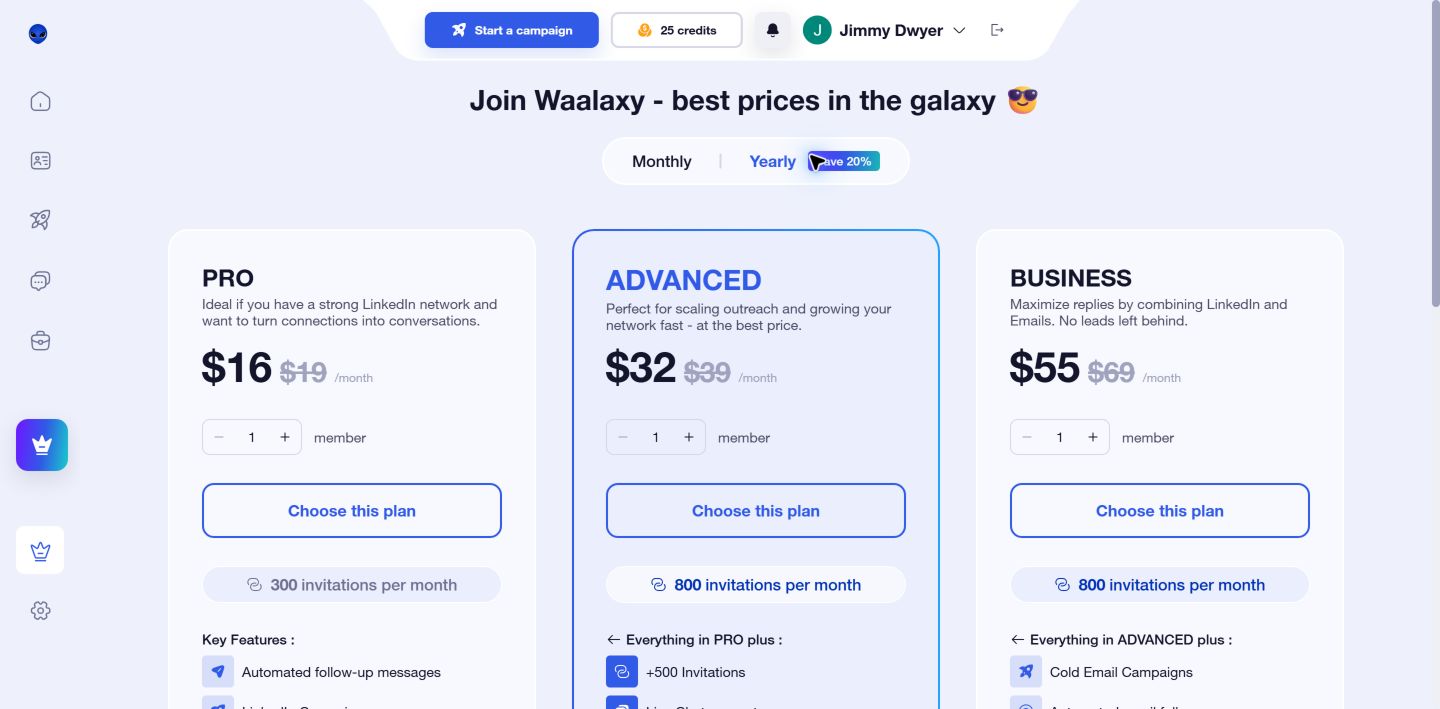
Currency and offer context, checked October 19: These dollar figures describe Jimmy’s signed-in Chrome session, where the account page and fully loaded public page matched. An independent retrieval of the public page still returned euro figures of €19/€49/€69. Waalaxy’s subscription guide says prices may vary by country, but we did not establish the precise regional/account mapping. Do not treat the euro and dollar amounts as equivalent currencies or assume one is universally obsolete. The same guide describes limited Freemium and several trial/conversion paths; we did not audit this account’s renewal setting.
What the findings change in our review
The completed CSV handoff, exact-repeat duplicate detection and retained zero-prospect draft support shortlisting Waalaxy for list preparation and sequence review before enrollment. Our buying review now uses these observations in its verdict and task checks. The unresolved direct-profile import, invitation-note notice and untested reply/CRM execution remain reasons to require a demonstration. This test does not establish outreach performance or account safety.
Limits and interpretation
This setup test establishes one CSV import, list persistence, a structurally verified export, exact-repeat duplicate detection and a saved zero-prospect draft. Message bodies, a configured company fallback and edited delays persisted after reload. The preview used built-in sample values; actual missing-field substitution was not tested. There was no live sequence, executed delay, acceptance or reply event, CRM transfer, deliverability measurement, account-safety test or numerical product score.
One self-owned profile is a Workflow test input, not a representative accuracy sample. The direct-import observation is not enough to diagnose a product-wide import problem; the later CSV result is not proof that all import sources behave identically. These findings help assess setup and review controls. They do not establish outreach performance or safety.
Re-test and correction history
- November 6, 2026 — Editorial clarification: The dollar-session observation remains dated October 19; its buying implication now points to the current euro pricing in the linked review and pricing guide. No observation, sample, test date or product execution changed.
- October 18, 2026: Initial setup session recorded a created list, one profile request and sequence selection. Import completion and saved draft persistence remained unconfirmed. No outreach was sent.
- October 18, 2026, resumed session: Rechecked the same empty list and Draft 0, inspected the CSV wizard without a completed upload, and advanced a zero-prospect setup to the invitation-note step with Add later. Saved draft persistence remained unconfirmed. No outreach was sent.
- October 19, 2026: Completed a one-profile CSV import and parsed its export: one row, 40 fields, matching supplied name/URL and blank contact channels. Repeated the same CSV to verify one duplicate and no extra row. Saved and reopened a zero-prospect draft to verify both messages, the configured company fallback and edited delays. Checked account/public pricing selectors and recorded the remaining FAQ and trial-offer differences. Final dashboard and queue showed no activity; no outreach was sent.
- October 19, 2026 · Editorial revision: Removed the repeated summary, aligned author and commercial disclosures, clarified the displayed LinkedIn identity, added rounded-price discount arithmetic and explained the effect on the buying review. Official help/policy research was added; no new product test or outreach was performed. The direct-profile import cause remains unconfirmed. Consolidated the test conditions and revision history for readability; original test dates remain unchanged.
- October 19, 2026 · Direct-profile retry: Submitted the same own-profile URL to a new empty list with duplicate movement off. Observed one scanned / zero success / zero duplicates / zero false positives; after refresh the retry list remained empty. Receipt completion and cause remained unconfirmed. This follow-up did not activate a campaign or send outreach.
- October 20, 2026 — Editorial revision: Clarified test-profile and downloaded-file inspection wording. Original observations and test dates are unchanged; no new product test was performed.