
Purpose and test conditions
Could we stage one known lead, export it and prepare an inspectable LinkedIn sequence before connecting a sending account? Jimmy Dwyer opened HeyReach’s self-service trial on October 22, 2026. The account displayed 13 days remaining, Free trial, zero seats used and zero Credits. It also stated that nothing would be charged after the trial ended. We recorded those notices without testing billing or paid-plan enforcement.
The fixed sample was Jimmy’s own LinkedIn profile. We supplied only his first name, last name and profile URL. The LinkedIn accounts page showed no connected accounts, and none was connected during the test. No activity was launched and no invitation, message or email was sent. This one-record setup check does not measure database coverage, delivery or campaign performance.
For product fit and alternatives, read our HeyReach review. Documentation claims about team operations remain separate from the setup observations below.
One CSV row imported and remained available
The CSV route required First Name, Last Name and LinkedIn Profile URL. HeyReach identified the one-row file and automatically mapped those three columns. We left location, headline, company, title, about and custom email unmapped, created a named test list and submitted the import.
The resulting list contained Jimmy Dwyer and the same profile URL. Refreshing retained that record. Headline, job title, company, location and about displayed empty placeholders; email finding and enrichment controls were disabled in this account state. We did not attempt a paid lookup or fill those fields ourselves.
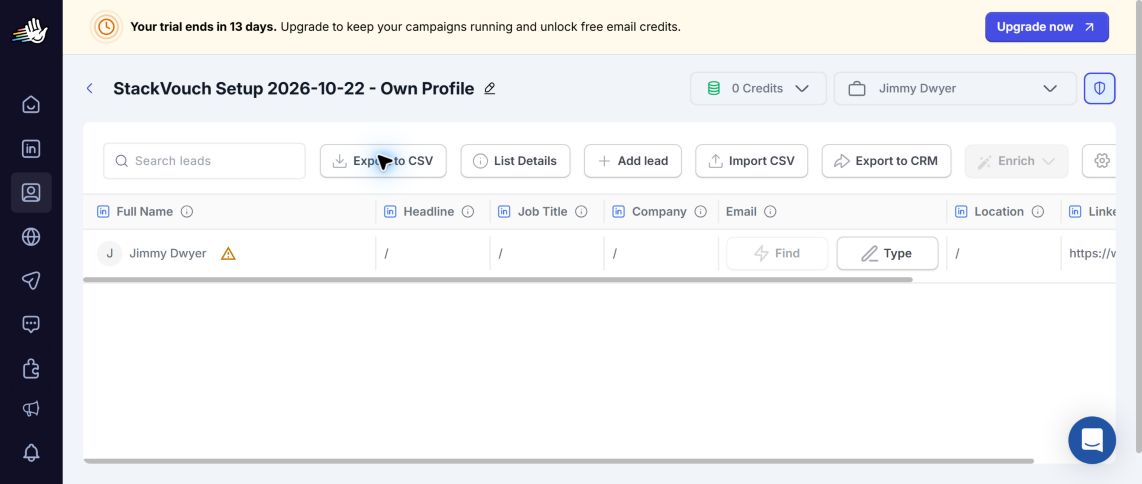
Export to CSV produced one data row with 18 headers and a file size of 340 bytes. Profile URL, First Name, Last Name and Full Name were populated; the other 14 columns were empty, including Enriched Email, company, job title and location. The name and URL matched our input. Full Name combined the supplied name fields.
This confirms a usable input-to-list-to-file handoff for one record. It does not establish that HeyReach found new profile information or verified a contact. We did not repeat the import, so duplicate detection is untested.
Invitation notes: variables, fallback and a Premium warning
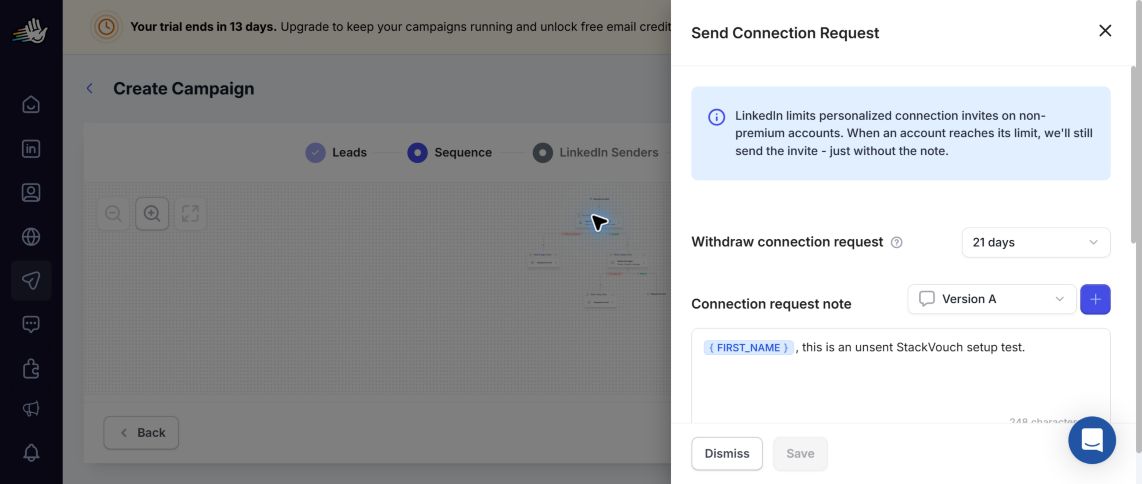
We created a campaign named with DO NOT LAUNCH and selected the saved one-lead list. In the blank sequence editor, a connection-request node created Accepted and Not accepted yet paths. Its note editor offered native variables and a separate fallback field.
After inserting FIRST_NAME, Save became disabled while fallback was empty. The editor displayed a character-limit warning and required fallback text. Adding a generic, explicitly unsent fallback enabled saving. Selecting Jimmy in Preview rendered his first name in the invitation note. This used the imported record rather than an unrelated example profile.
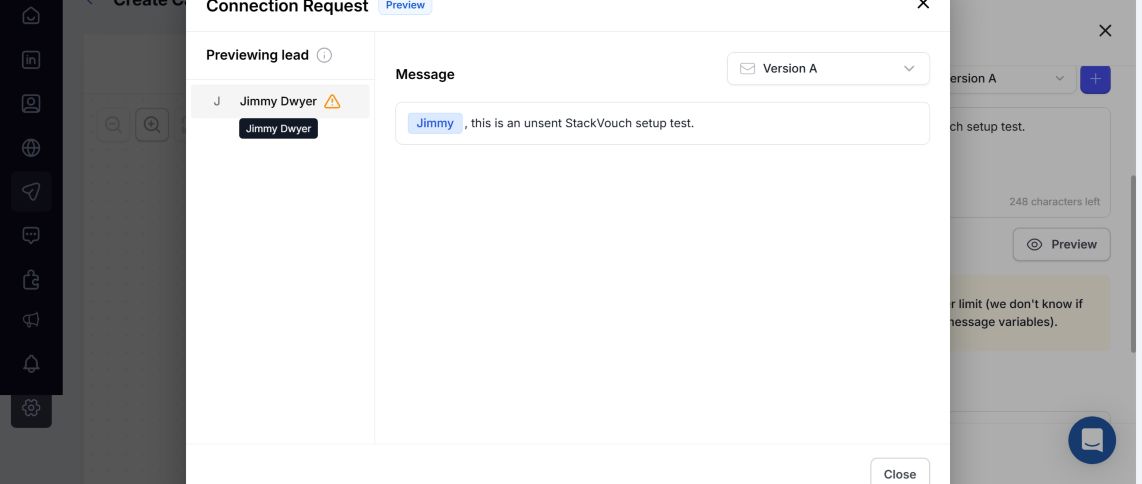
The editor also warned that LinkedIn limits personalized invitations on non-premium accounts and that invitations could be sent without their notes once that limit was reached. We did not test the limit or a Premium subscription. Buyers should check whether a note is essential to their intended invitation before approving execution.
Branches, two-day delay and saved text
On Accepted, we added a text message and changed the default one-day wait to two days. We saved an explicitly unsent primary body and a distinct fallback body. We ended the Not accepted yet branch with its default five-day wait and the No reply yet branch with its default one-day wait; the Replied path already led to an end node.
After refreshing and reopening the sequence, the two-day message delay and branch endings remained. Reopening both action editors confirmed that the invitation variable, invitation fallback, message body and message fallback were retained.
These are storage and editor checks. We did not observe a real acceptance, reply, timeout, invitation withdrawal or fallback selection during delivery. Drawn branch logic does not prove those events will execute as expected.
No sender: the actual stopping point
Continue advanced from Sequence to LinkedIn Senders. That page stated that there were no senders and disabled Continue. We stopped there, preserving the boundary against connecting an account. Schedule and the final campaign preview were not tested.
The campaign list then showed the named campaign as Draft. There was no launch, and Credits remained at zero.
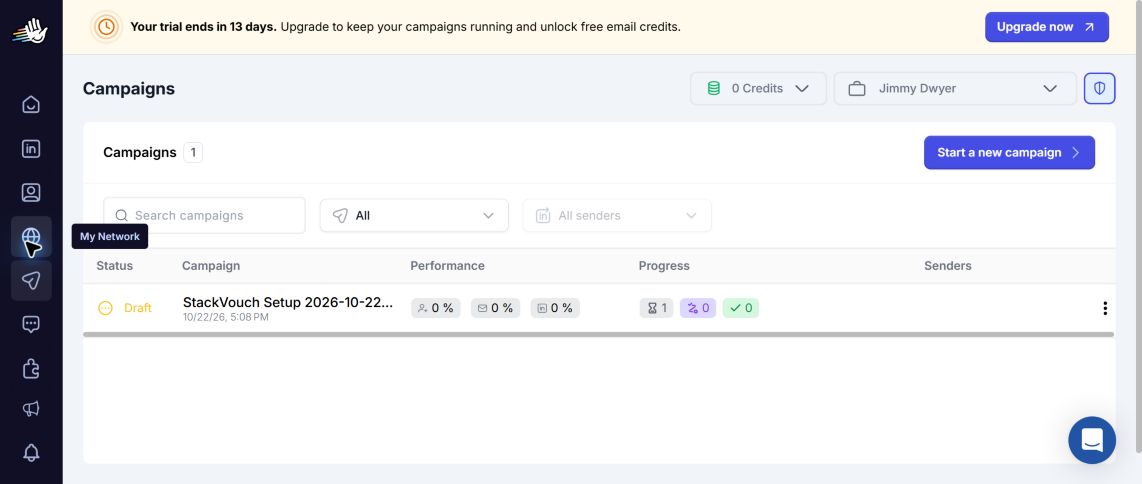
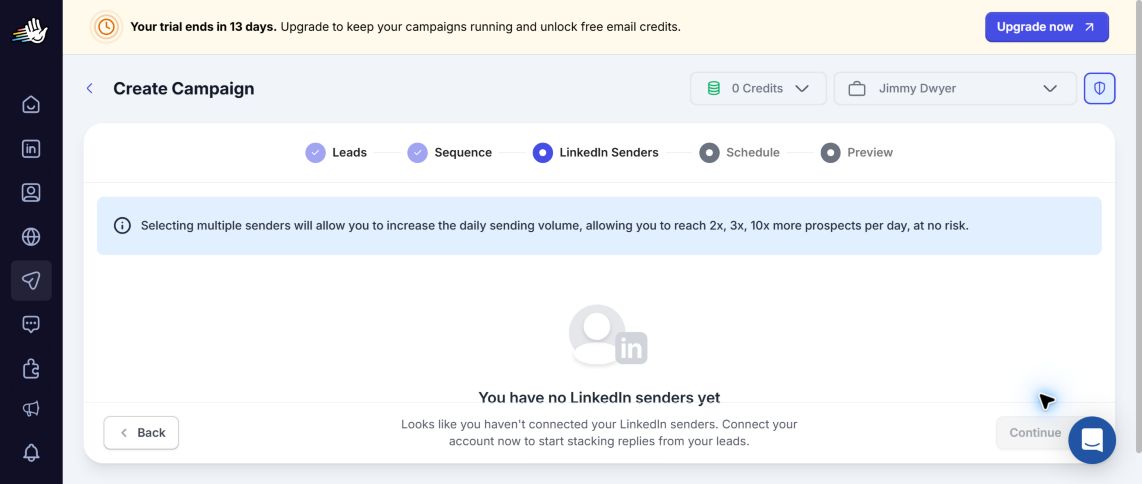
This is useful for teams wanting to inspect inputs and draft messages before connecting a sender. It does not establish reply ownership, shared-inbox access, sender rotation or client isolation—the operational reasons many buyers consider HeyReach.
Trial credits and price context
Billing described Credits as paying for verified-email and LinkedIn-URL finding. The zero balance did not prevent this CSV import, export or draft editing. No enrichment credit was purchased or consumed, and we did not establish how successful or failed lookups are charged. HeyReach’s credit documentation treats enrichment credits separately from sender subscriptions.
The following dollar-sign offers were displayed inside Jimmy’s account on October 22. Growth was priced per sender; the other rows were bundles. These are account-session quotes, with no country mapping, tax or checkout confirmation.
| Account plan label | Sender basis | Monthly billing | Displayed annual monthly equivalent | Explicit annual total |
|---|---|---|---|---|
| Growth | Per sender | $79 | $63 | $758 |
| Micro Agency | 25 senders | $999 | $799 | $9,590 |
| Agency | 50 senders | $1,399 | $1,119 | $13,430 |
| Unlimited | Unlimited label | $2,999 | $2,399 | $28,790 |
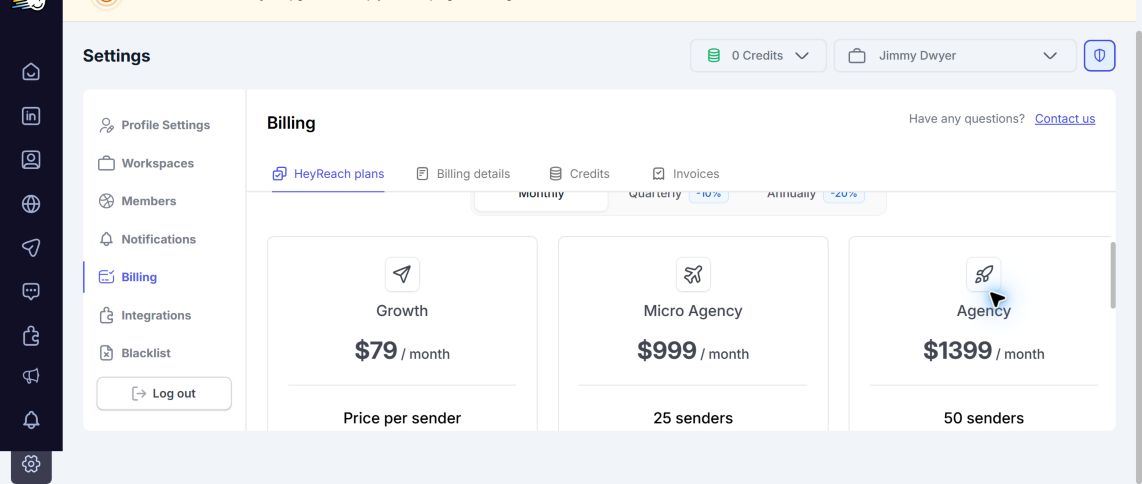
The public pricing page differed: Growth’s yearly total was $756, compared with $758 in the account. It grouped 25/50-sender options under Agency, while the account called the 25-sender bundle Micro Agency. It also disclosed a 300-sender fair-use cap for Unlimited. A possible explanation is rounding: $79 × 12 × 0.8 = $758.40, whereas a rounded $63 monthly display × 12 = $756. The $758 account label could reflect rounding the discounted annual input. This is an editorial inference, not a vendor-confirmed billing rule; confirm the applicable total at checkout or with support. The applicable quoted total remains unconfirmed. Use the applicable explicit commitment at checkout rather than multiplying a rounded monthly equivalent; we did not buy a subscription.
Risks and limits
LinkedIn’s policy prohibits unauthorized third-party automation and warns that accounts can be restricted or closed. Our disconnected, inactive setup does not establish account safety. HeyReach’s in-product risk assurances were not tested outcomes.
This report does not test LinkedIn authentication, sending, scheduling, live reply stopping, inbox handoff, multi-sender rotation, multi-user permissions, CRM transfer, enrichment accuracy, API or MCP execution. We also did not test malformed rows, missing required values, duplicate imports or another lead. There is no timing benchmark or numerical StackVouch score from this session.
What the findings change in our review
We can now support first-hand claims that one known profile can be staged through CSV, retained, exported and used to preview a name variable without connecting a sender. Tested invitation and message text, fallback bodies and delay settings survived reload. The sender requirement is a clear boundary before later setup steps.
That supports a narrow setup strength, while leaving HeyReach’s team and agency outcomes unverified. A purchase decision still needs a demonstration on your intended plan of permissions, reply handling and sender operations, alongside acceptance of LinkedIn’s platform-policy risk.
Re-test and correction history
- October 22, 2026: Original setup test. One tester-owned profile imported and exported; invitation and message drafts reloaded; sender gate documented. No sender connected or campaign launched. Public/account Growth annual-total difference recorded.
- October 25, 2026: Added the explicitly inferred rounding explanation for Growth annual totals and separated sender/enrichment test boundaries from product Cons. No checkout, enrichment or sending retest.