
Purpose and test conditions
Could a small B2B sales team find contacts, retrieve primary email data, organize three lists, export a usable file and prepare an inactive sequence? This report records those operations in one Professional Trial account on October 16, 2026. It is a dated workflow snapshot, not a database-accuracy benchmark.
We exported 30 distinct records, received 28 primary email values and recorded 28 email credits used. A two-step inactive sequence also preserved its content and timing settings after reload. No emails were sent and no contacts were enrolled in that sequence.
For current plans, usage terms and alternatives, read our Apollo review. This report does not establish whether replacing your existing sender or CRM would improve results.
What we tested
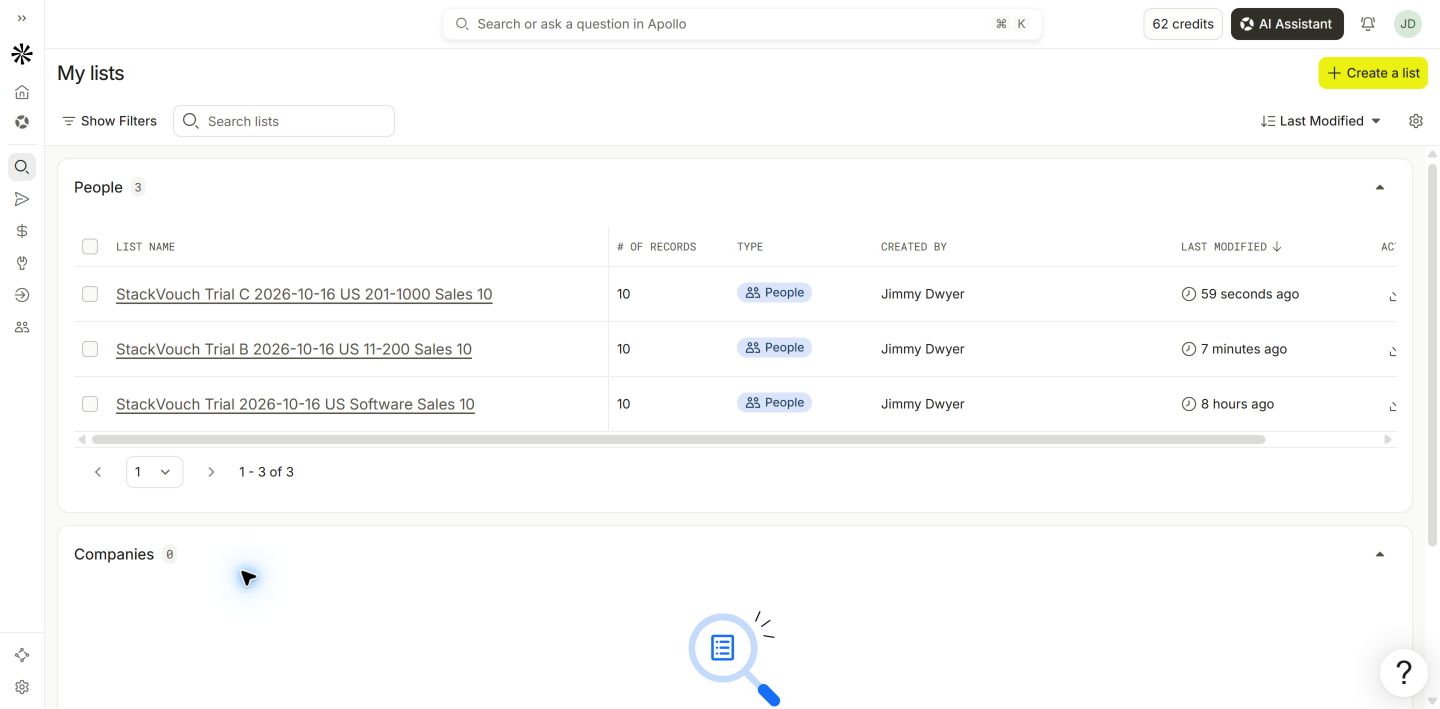
We used a one-seat Professional Trial on October 16, 2026. For each search, we selected the first ten results in Relevance order after applying the declared conditions. We kept records with unavailable email data instead of replacing them. B and C used Net New to avoid previously saved records, and file checks confirmed 30 distinct contact IDs across the exports.
| Search | Company and person criteria | Title settings |
|---|---|---|
| A: broad baseline | US company HQ; Computer Software industry; no person-location or employee-count restriction | Sales manager; default similar-title setting |
| B: smaller target companies | US company HQ and US person location; Computer Software; 11–200 employees | Sales manager, sales director, head of sales, VP of sales; similar titles off |
| C: larger target companies | Same geography/industry as B; 201–1,000 employees | Same title settings as B |
We used Apollo-only enrichment for all saves. Waterfall was disabled for each operation, and catch-all emails were included. No email-status filter was applied to choose favorable results. Title strings were not enclosed in quotation marks; turning off similar titles does not establish exact-string-only matching.
These are convenience samples from one trial account. They demonstrate the recorded workflows and identify questions a buyer should test. They are too small and selectively scoped to measure database-wide accuracy, deliverability or comparative superiority. Company size and geography in the results are Apollo fields, not an external census.
Results: 30 exported records, 28 populated primary emails
| Observed result | A | B | C |
|---|---|---|---|
| Records selected and exported | 10 | 10 | 10 |
| Populated primary email | 10 | 9 | 9 |
| Verified in the downloaded CSV | 10 | 8 | 9 |
| Verifying in the downloaded CSV | 0 | 1 | 0 |
| Unavailable | 0 | 1 | 1 |
| Labeled Catch-all | 3 | 3 | 2 |
| US person country in CSV | 4 | 10 | 10 |
| Additional email credits recorded | 10 | 9 | 9 |
The export files each contained 10 rows and 79 columns. All three lists ultimately showed ten records. We found no repeated contact IDs across the three files. These results measure record retrieval and file consistency; the presence of an email value does not establish that it belongs to the right person or will accept a message.
What the search filters mean in practice
Company headquarters and contact location solve different tasks
Our baseline restricted company headquarters to the United States. Six of its ten contacts had non-US person locations. That is consistent with the company filter: a US-headquartered organization can employ people elsewhere.
When we added US person location for B and C, all twenty exported person-country values were United States. For a territory-based team, this is a practical configuration check before revealing emails. Use both fields if both matter to your campaign; use only the company field if international employees of US accounts are valid targets.
Computer Software does not define your ideal customer
The industry filter returned companies whose sites describe software together with consulting, hardware, payments or managed services. Those classifications can be reasonable while still being broader than a buyer's intended niche.
Anonymous examples included a retail software business that also supplies hardware, a development-and-consulting business, and a software service with substantial human support. Whether these belong in your list depends on what you sell. We omit company and individual links to avoid indirectly identifying sample members.
We reviewed the company websites for all three samples; one third-cohort site could not be retrieved. We did not remove mixed or unresolved businesses from the sample after seeing them. A more targeted search gives you a narrower starting set, but you still need a business-fit decision.
Role relevance needs its own check
We reviewed public professional sources for 20 records: ten in A and ten in B. We classified the strongest available evidence for each record once, using the categories below. An explicit matching sales-role statement counts as support; association without a usable exact title does not.
These counts describe public-source support, not Apollo accuracy. Missing evidence is not an incorrect record.
| Public-source result | A | B | Total |
|---|---|---|---|
| Matching sales role explicitly supported | 0 | 2 | 2 |
| Different or incomplete title wording | 1 | 2 | 3 |
| Possible role transition; current role needs rechecking | 1 | 0 | 1 |
| Insufficient evidence for the exact role | 8 | 6 | 14 |
| Records checked | 10 | 10 | 20 |
The two supported cases came from employer-authored material. Different wording included a senior sales title variant and a broader executive title without the exported sales suffix. Indexed profiles may be stale; absent information is not an incorrect record. C's ten individual roles were not assessed. Company association and seniority also do not prove buying authority.
Verified, Verifying and Catch-all: keep the distinctions
Across the downloaded snapshots, 27 records were labeled Verified, one Verifying and two Unavailable. Eight records also carried a Catch-all label. These are Apollo's exported classifications.
The B save dialog initially counted nine Verified emails. Its immediate export contained eight Verified and one Verifying. We retained that difference instead of assuming the pending record had already passed verification.
For a buyer, the operational lesson is to preserve the status fields through export. Put unavailable records into a research queue. Recheck a pending verification before treating it as complete. Keep catch-all handling visible in your team's acceptance policy.
These supplier labels describe the export snapshot; they are not an independent email-quality result.
Credits: what our actual workflow cost
The account's Email usage ledger increased by 10 credits for A, nine for B and nine for C: 28 email credits in total. Available balance at the end of prospecting, before the sequence test, was 62 out of 90.
Allocation note: the displayed allowance rose from 75 to 90 for an unestablished reason. Later onboarding notices showed two five-credit rewards, which do not explain the earlier change. We therefore use cumulative Email usage, not balance subtraction.
Before saving a ten-record batch, Waterfall was enabled and the dialog estimated 10–40 credits. Disabling it for that save changed the estimate to 0–10 with Apollo enrichment. We did not run a Waterfall comparison, so the estimate is not a measured saving or a coverage comparison between providers.
| Action in this test | Evidence and implication |
|---|---|
| Retrieve primary email with Apollo-only saves | 28 email credits recorded across 30 selected records |
| Export existing saved A records | The captured export-history event showed ten records and zero export credits |
| Export B and C after saving | Both CSVs were downloaded; their export-event credit totals were not separately captured |
| Repeat adding B's ten saved records to the same list | List remained ten; no additional visible email consumption at that checkpoint |
| Retrieve mobile numbers, run Waterfall or sync to CRM | Not exercised; obtain a separate estimate for your workflow |
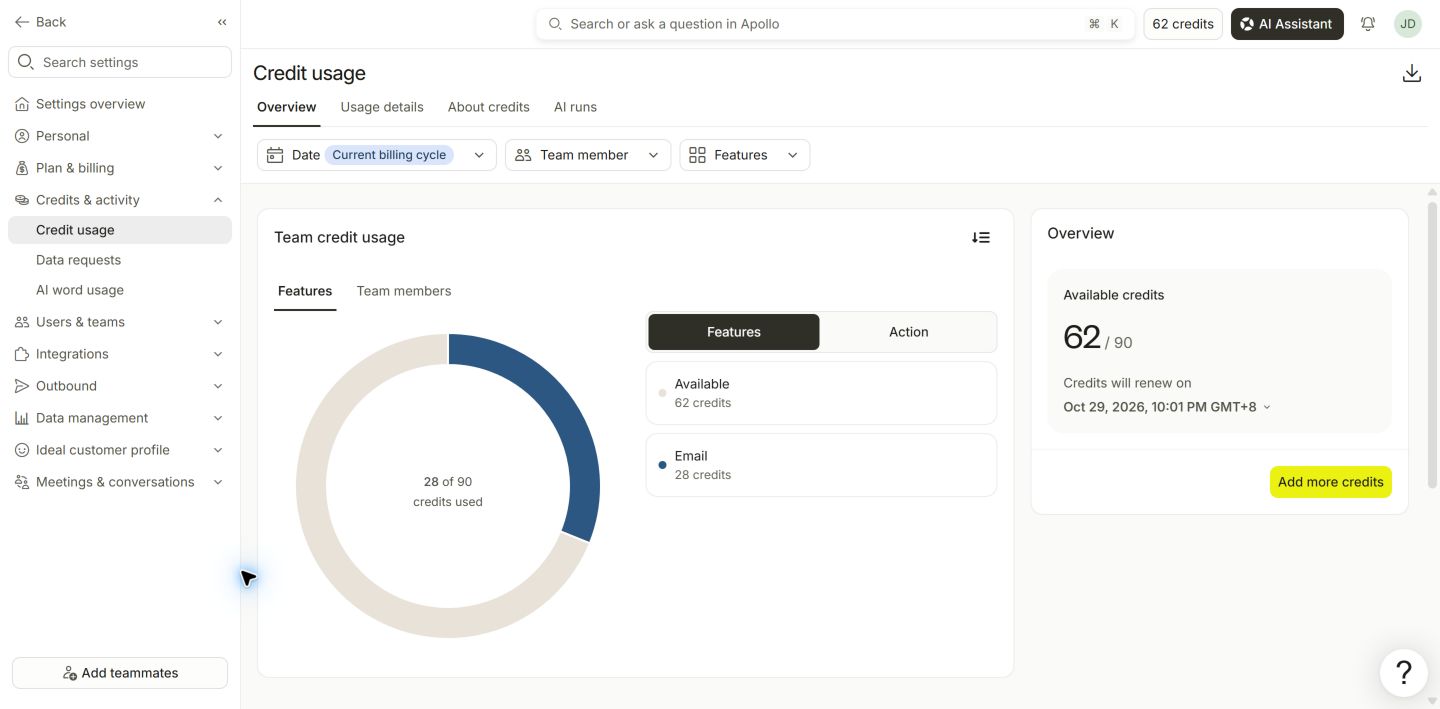
Across all cohorts, 28 recorded email credits divided by 28 populated primary emails is one email credit per returned primary email (28/30, about 0.93 per selected record). This agrees with Apollo's documented one-credit verified-email access rule for the observed save workflow. One exported record was still Verifying; the aggregate agreement does not establish that record's final status or its individual charge.
Apollo's contact-export guide says exporting already saved contacts does not use credits; saving net-new contacts with verified email data uses credits first. This supports the A export observation. It does not fill in the missing B/C event measurements. Other credit-bearing actions, including some company-data exports, have separate rules. Neither the subscription cost nor qualification time is included in our one-credit figure.
Lists and CSV: a usable handoff with checks still needed
We created a separate named list for each sample and verified ten records in each. Adding B's same ten saved contacts again left its list count at ten. This supports the behavior of that repeat membership action; it does not test duplicate CSV imports or CRM merging.
All three CSVs parsed successfully, each with 79 columns. Contact IDs made overlap checking possible. The files also preserved supplier email status and catch-all labels, which matter more to the next step than the raw column count.
A practical handoff should retain:
- Identity, title, company, website and professional-profile URL.
- Person country, company country and company-size field.
- Primary email, status, catch-all label and verification/source fields.
- A stable record ID and your team's qualification decision.
Keep the original export separate from a compact working view. Twenty-eight populated email fields can be useful for further review; they are not a send-ready acceptance result. Qualification time and subscription costs still belong in the handoff budget.
Sequence editing: variables, missing fields and timing
We created a clearly labeled test sequence and left it inactive. We saved an automatic-email template and an action-item step, then reloaded the page to check that the content persisted. The Contacts tab showed 0 total. Selecting a contact for preview did not enroll that person in the sequence.
| Editor check | What we observed | What a buyer should do |
|---|---|---|
| Subject and body variables | First name and company resolved in previews for two existing saved contacts | Preview several records, not only the first populated example |
| Optional education field | The Major variable rendered a value for one contact; the other preview retained {{contact.major}} |
Inspect optional fields before approving a template |
| Conditional fallback | An if/else condition displayed the available-data branch for one preview and the fallback for the other | Write and preview both branches for your own required fields |
| Email wait | Changed the first email's default 30-minute wait to one day; it persisted after reload | Check the wait alongside the sending schedule |
| Action-item timing | Changed the displayed due date from three days to two; the UI described immediate task creation with a later due date | Distinguish a task deadline from an email-send delay |
| Saved state | Both steps and the conditional template survived reload; sequence remained inactive with zero contacts | Verify the saved draft and recipient count before any future launch |
For the fallback test we used {{#if contact.major}}Education detail available.{{#else}}Education detail not used.{{#endif}}. These were editorial test messages, not a live outreach campaign. The useful finding is that a polished preview with complete data does not prove the same template handles absent fields: in this test, the unguarded variable remained visible for the second record, while the conditional version rendered the intended fallback.
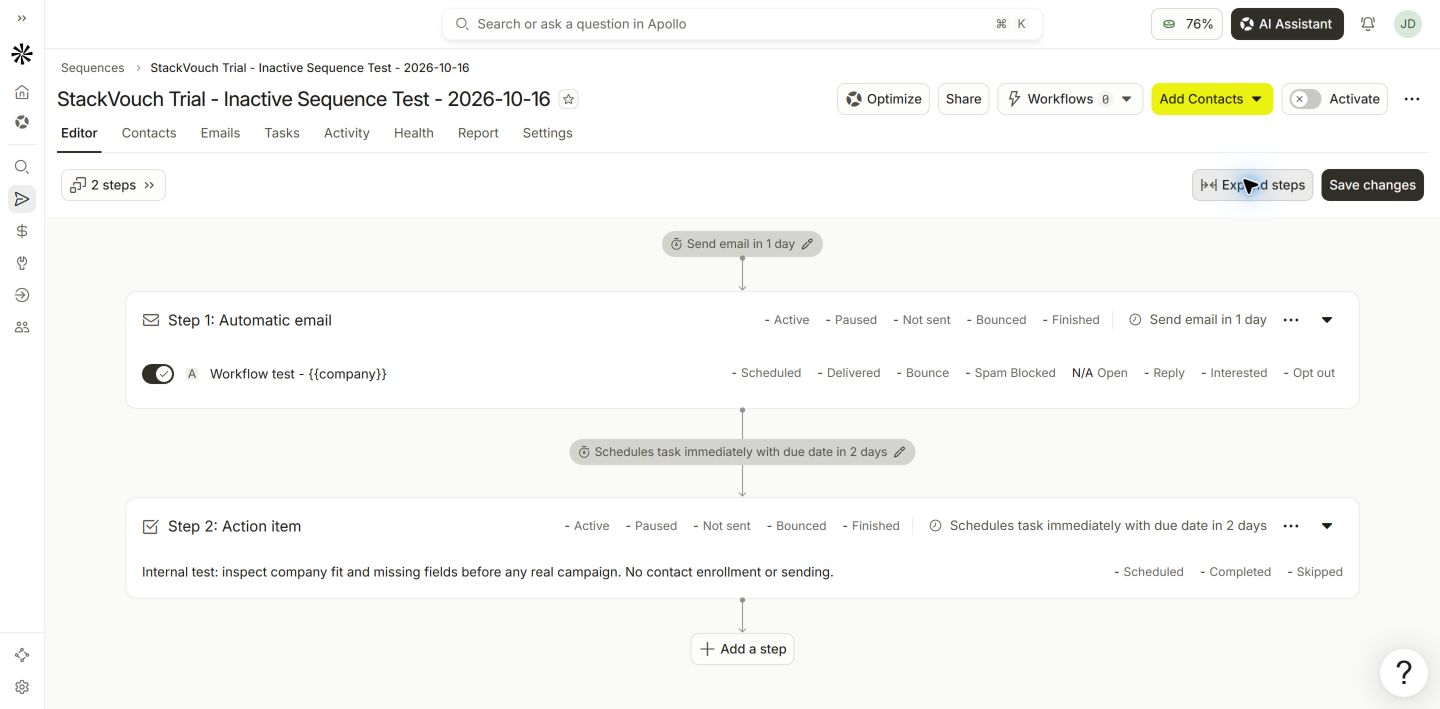
Draft editing, variable previews and saved timing settings worked in the cases tested. Before replacing an existing sender, run a separate authorized sending test using addresses you control; editor behavior alone does not establish campaign performance.
Limits and interpretation
These three convenience samples are not representative of Apollo's entire database or of every customer's market. We did not independently verify email ownership, deliverability or current employment for every record. Individual employment checks covered A and B with unresolved cases; C received company-site checks only. Catch-all and verification labels came from Apollo. No competitor ran the same protocol, so there is no comparative ranking.
We did not test live sending, phone retrieval, CRM sync, API usage, Waterfall execution, renewal or full-volume economics. No stopwatch-based onboarding or correction-time measurement was made. Loading/security-widget interruptions required session recovery, but elapsed session time is not a human onboarding benchmark. Mailbox authorization was outside the recorded editor test.
Original CSVs were retained privately with checksums. We publish aggregate results and selected screenshots, excluding prospect names, email addresses, phone numbers and contact IDs. The 30-row field audit found 30 distinct IDs across three 79-column exports. Results do not award or change a numerical StackVouch Score.
What the findings change in our review
Search, saving, list organization and CSV export all completed. We recommend shortlisting Apollo when a small sales team wants these jobs connected in one workspace. Separate person/company geography filters and preserved status/ID fields give a team practical inspection controls. Broader industry classifications, catch-all outcomes and unresolved field values require qualification work. Conditional previews helped handle the two optional-field cases tested; live execution remains untested.
The main review uses these observations alongside attributed product research. A positive workflow result does not make every documented capability hands-on tested. Return to the Apollo buying verdict.
Re-test and correction history
- 2026-10-16: Original test: three fixed samples, 30 distinct exported records and an inactive two-step sequence. No later re-test has been performed.
- 2026-10-17: Report published October 17; test conducted October 16. Added aggregate role-source counts, anonymous examples and export-credit clarification from the existing records. Official export and credit rules checked October 17. No new contact sample or sending test; the original test date is unchanged. A future re-test will identify its own conditions and sample.
- 2026-10-18: Clarified attribution and the result summary, moved the role-source caveat before the table, updated pricing-context wording and completed the revision record. No new product test; the test date remains October 16.