
Purpose and test conditions
Could we prepare a LinkedIn workflow, preserve its conditions and messages, and move one authorized test profile into an inactive campaign? Jimmy Dwyer opened the self-service trial on October 18, 2026. The account displayed seven days remaining and an October 25 expiry. Dripify describes the trial as Advanced-plan access; we tested only the editor and setup tasks below, not paid-plan enforcement.
We saved and reloaded a reusable sequence with an invitation node, a message, delays and an If viewed message condition. The message’s primary and fallback bodies persisted. We then submitted Jimmy Dwyer’s own LinkedIn profile URL to a named campaign list. It remained pending: the collection report showed one requested, zero added and one still to be added.
This is a workflow snapshot. We did not launch the campaign, send messages or measure outreach results. A single tester-owned profile is not a contact-data sample or a representative usability study.
The campaign stayed off throughout setup, and the final activity counts showed zero invitations, messages, emails, profile views and contacted leads. We did not inspect which LinkedIn account was connected, its authorization permissions or whether it was dedicated to testing. Submitting Jimmy’s own profile URL does not establish those connection details. These limits do not establish account safety.
For current buying guidance, plan context and platform-policy limits, read our Dripify review.
What we tested
We began with no campaign or activity records. We created an explicitly labeled draft and used Settings > Sequence templates to edit a reusable sequence without importing contacts first. Later, we used Jimmy’s own LinkedIn profile URL for the test; the campaign remained off.
| Operation | Observed result | Limit |
|---|---|---|
| Save an empty campaign | Named draft appeared with zero leads and zero contacted | No launch validation |
| Build a reusable sequence | Invitation, message, condition and explicit end nodes saved | Editor configuration only |
| Change accepted-branch delay | Two days persisted after template reload | No timed execution |
| Set unaccepted branch to stop | Stop processing persisted | No late-acceptance event tested |
| Insert variables and preview | First name and company rendered with a built-in example | No actual imported record preview |
| Save a fallback body | Text survived reload | Missing-field fallback selection untested |
| Apply saved template to campaign | Tree and primary text appeared in campaign editor and saved | Not every field rechecked after campaign reload |
| Submit one test profile URL | One requested; zero added; one pending | Collection stopped while campaign inactive |
Branches and delays: settings worth reading closely
The invitation node created accepted and still-not-accepted paths. We changed the accepted path’s delay from one day to two days, then added a Message node. After another one-day delay we added If viewed message, ending both resulting branches.
Our first save attempt was rejected because the sequence branches were not closed. Explicit end nodes resolved the validation and allowed the template to save. This was a useful editing check, but it does not establish that every unsafe or incomplete sequence would be caught.
The still-not-accepted end node had a less obvious choice. Its default was to wait until an invitation was accepted; the popup explained that a later acceptance could continue down the accepted path. We instead selected Stop processing, whose explanation excluded later continuation for a lead that had already reached that endpoint.
For buyers, ending a drawn branch and stopping all future processing are separate configuration questions. Read the selected end mode as well as the delay. We confirmed what the editor saved, not what happened after a real late acceptance.
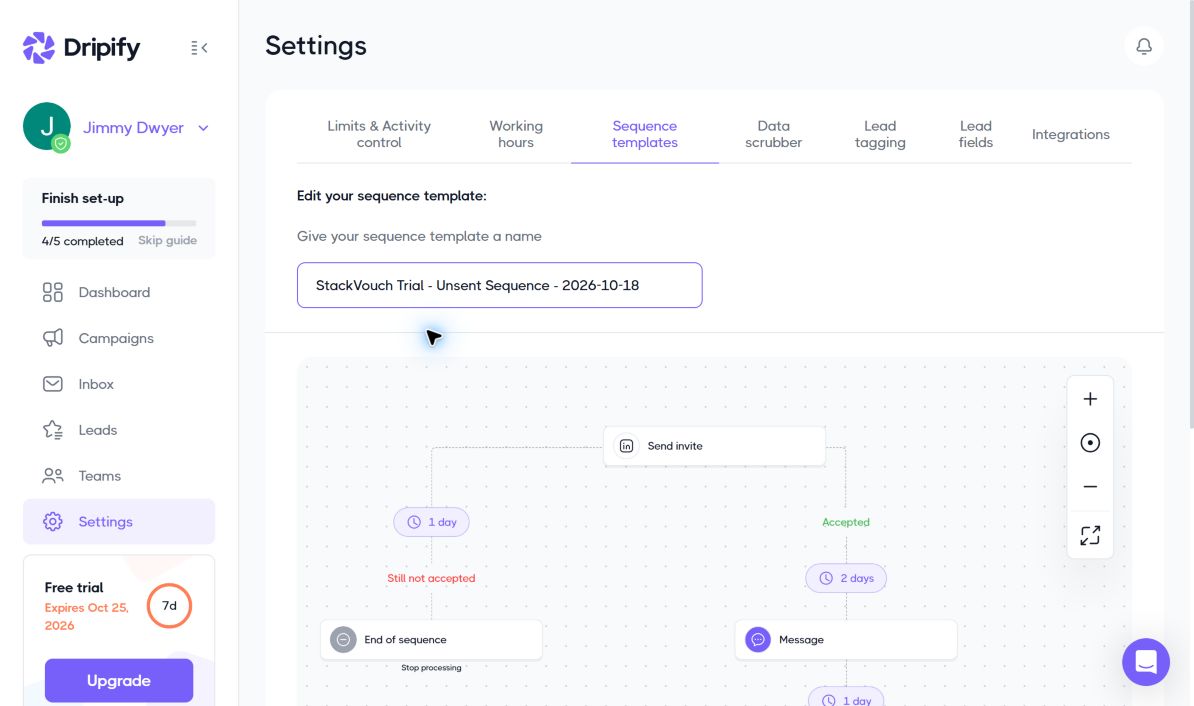
Personalization: sample preview versus real missing data
The native controls supplied first-name and company variables in %%first_name%% and %%company%% form. We entered an explicitly unsent editorial test message. Preview rendered Bruce and Wayne Enterprises, indicating a built-in example rather than the tester’s own profile.
The editor also offered a separate fallback message tab. We entered a generic greeting and a body that did not require company data. Both the primary message and fallback text survived saving, reopening and reloading the reusable template.
That confirms storage, not fallback execution. Because the test profile never became a parsed lead, we could not compare a populated real record with a missing-company record. A buyer should perform that check before approving live personalization.
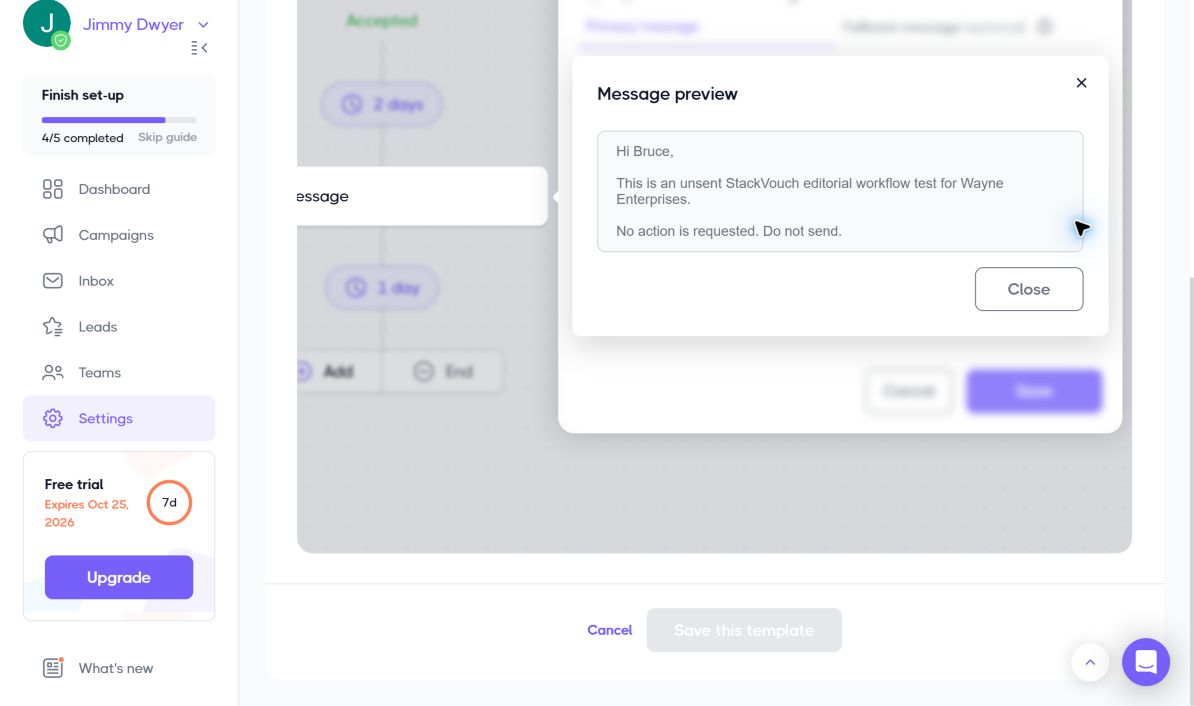
The invitation-note editor had a separate restriction in this account: variable controls were disabled and it displayed a LinkedIn Premium notice for personalized notes. We did not upgrade or test another subscription. A message-body preview should not be treated as proof that personalized invitation notes will also work.
One URL requested does not mean one lead imported
We used Paste profile URLs, submitted the tester’s own URL and kept the default rule excluding leads found in other campaigns. The list-name field rejected a name longer than 50 characters; a shorter test name succeeded.
After choosing our saved sequence, the app advanced to campaign Settings and said the campaign was ready to launch. Webhooks and HubSpot were unchecked. The campaign activation control remained off.
The Audience view then showed zero added leads and one uploading. More usefully, its notice explained that Dripify had stopped adding leads because the campaign was paused and would resume when the campaign was enabled. The collection report confirmed:
| Collection result | Count |
|---|---|
| Requested | 1 |
| Skipped | 0 |
| Added to the list | 0 |
| Still to be added | 1 |
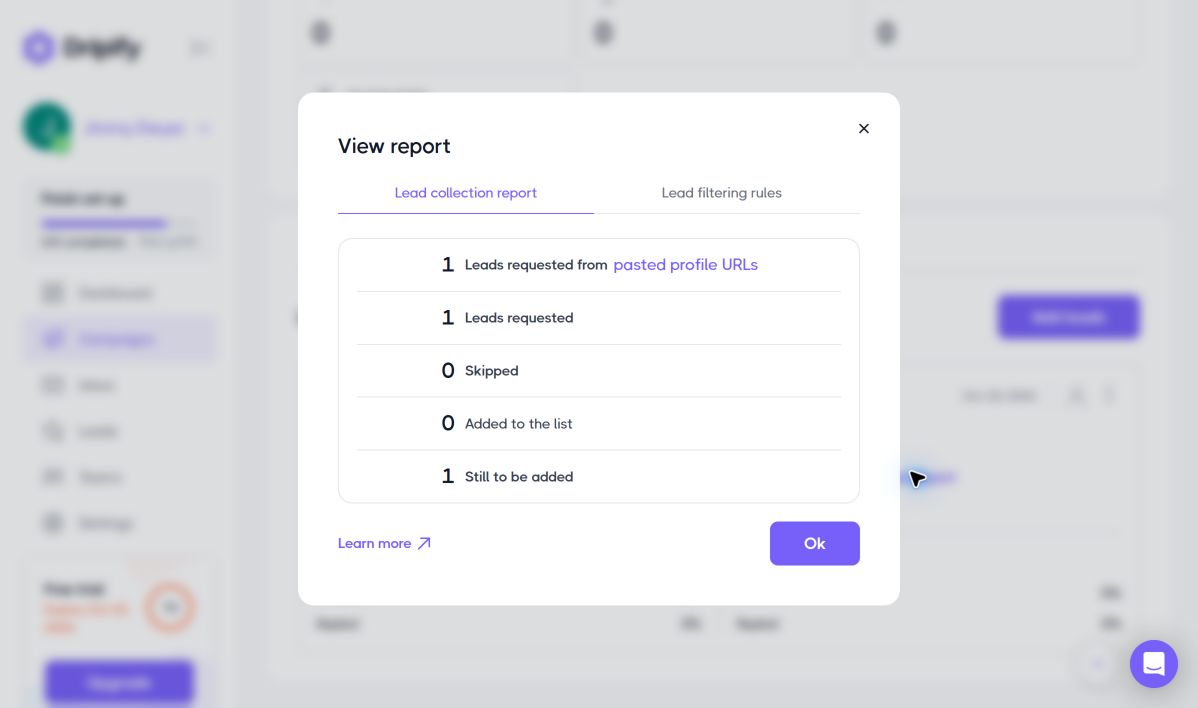
We retained the inactive state. The pending item is not evidence of an invalid profile, a failed lookup or poor database coverage. Lead collection stayed pending while the campaign was off.
This matters if your team wants to inspect collected fields before it permits any execution. Validate that staging process explicitly. Our completed editor test does not establish a completed lead-import or export handoff.
Trial settings and purchase context
The dashboard’s current allowances were five invitations, five messages, twenty emails and five profile views. Settings also displayed Activity control as active. We left those settings unchanged. These account-specific values are not measured daily throughput or proof of protection.
The account’s upgrade screen showed Pro at $79 per user/month on monthly billing and $59 equivalent when billed annually; Advanced showed $99 and $79 respectively. No purchase or checkout was performed.
On October 18, the public pricing page showed Pro, Advanced and custom-priced Enterprise. Its plan card and FAQ assigned A/B testing to Advanced; the account screen agreed. This current check did not reproduce the older Pro-versus-Advanced source conflict. We did not run an A/B test or validate paid-tier enforcement.
Limits and interpretation
The final dashboard showed zero invitations, messages, emails and profile views, no recent activity and zero contacted leads. The campaign was configured but inactive. Its name contains DRAFT ONLY, but the actual off activation control is the evidence of inactivity after setup.
We did not test collection completion, actual profile-field accuracy, CSV export, email finding, credit consumption, inbox handling, reply-triggered stopping, sending, CRM transfer, permissions across teams, A/B outcomes, renewal or long-term account safety. The editor’s reply-pause notice is a product statement, not an observed reply event. No setup-time benchmark or numerical StackVouch Score follows from this session.
The strongest result is a reusable, inspectable sequence whose tested configuration persisted. The most decision-relevant limitation in this run is the paused collection dependency. Teams evaluating Dripify should demonstrate the route from approved input through collected records and pre-launch review, then authorize any execution separately.
What the findings change in our review
We can now support narrow first-hand claims about Dripify’s sequence editing, explicit branch closure, delays, stop-mode selection, sample preview and saved fallback text. We can also document an attempted one-profile import and its precise pending state.
We cannot yet describe prospect entry through export or reply handling as a completed workflow. The observed editor strengths should be added alongside those exclusions, without turning vendor protection language into a safety result. Current plan descriptions should be refreshed before reusing older Basic-tier comparisons.
Re-test and correction history
- 2026-10-18: Original trial session. Completed reusable-template and inactive-campaign setup checks. One authorized test URL remained pending; no campaign was activated. Published the setup findings and explicit limits. Later the same day, clarified the Setup test scope, trial context and attribution, and corrected the publication wording. Consolidated the trial context, clarified the unassessed LinkedIn connection details and aligned the Setup test navigation label. No new product test was performed.
- October 20, 2026 — Editorial revision: Clarified test-profile wording. Original observations and test dates are unchanged; no new product test was performed.