
Purpose and test conditions
Could we find relevant contacts, retrieve email values, keep a named list and export it using Lusha’s Free plan? Jimmy opened a self-service account on October 19, 2026. We used a fixed sample of ten contacts and the account’s existing credits. The account identified its plan as Free; this was not a time-limited paid-plan trial.
The first account menu showed zero of 40 credits used. Before any contact reveal, the allocation changed to 50, with zero used. We did not establish the reason. Subsequent usage measurements all used that 50-credit allocation.
No mailbox or CRM was connected during testing. No contact was enrolled into a sequence, no email was sent and no paid upgrade was purchased. This is a Workflow test, not a database-accuracy or deliverability benchmark. For broader buying context, read our Lusha review.
What we tested
We selected the first ten results in the default displayed order after applying these filters. No email-availability or status filter was applied, and gated records were retained rather than replaced.
| Filter | Setting |
|---|---|
| Company headquarters | First displayed United States suggestion |
| Contact location | First displayed United States suggestion, selected separately |
| Industry | Software Development, Lusha’s displayed category |
| Company size | 11–50 and 51–200 employees |
| Job title | Sales Manager suggestion |
| Additional selection | No company-name targeting, manual reranking or AI query |
The results count settled at 11,177. That is the vendor’s displayed result count, not an independently verified population. The UI offered two identically worded United States suggestions; our procedure used the first displayed option for each location field. The test does not establish their underlying geographic mappings or exact-string title matching.
The first page contained 25 results. The first two of our ten were selectable and showed full names; the next eight were masked. The sample was fixed before email retrieval. It is one convenience sample from one account and is not directly comparable to Apollo’s different filters, plan or 30-record sample.
Email access: two values and eight paid-plan gates
We selected the first two records and chose Show emails, rather than revealing phone data. Used credits increased from zero to two. The two email values became visible in the saved table. Phone values stayed masked.
For each of the remaining eight records, we opened Show details once. Each displayed a paid-plan restriction explaining that contact details for certain US states were available only on paid plans. We did not upgrade or substitute other contacts. Usage remained two credits after all eight checks.
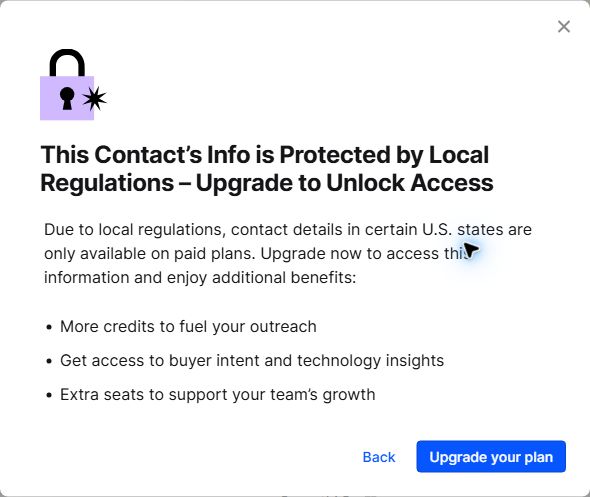
This is evidence of plan access in this sample. It is not evidence that eight records were inaccurate or absent, nor an estimate of Lusha’s US-wide coverage. The explanation is Lusha’s UI statement; we did not independently assess its legal basis.
We did not independently verify either email’s ownership, employment association or ability to receive mail. No email-validation service or delivery test was run. Two displayed addresses establish retrieval, not accuracy.
Credits: the measured workflow cost
| Checkpoint | Used credits | Change |
|---|---|---|
| Before revealing contacts, after allocation became 50 | 0/50 | Baseline |
| After Show emails for the first two contacts | 2/50 | +2 |
| After checking eight paid-plan gates | 2/50 | 0 |
| After requesting the two-record CSV export | 3/50 | +1 |
| After table transfer and one repeated addition | 3/50 | 0 |
The export confirmation quoted one credit for every 25 contacts. Export History subsequently recorded one credit for this two-record job. This small batch therefore cost three credits in total, including the two email reveals. It does not establish the cost of a larger batch or a different export route. The final sidebar showed 47 credits available.
The unexplained allocation increase from 40 to 50 happened before reveals. We do not count it as consumption, describe it as the published Free-plan allowance or attribute it to a particular reward.
Named-table saving, persistence and an exact repeat
The Prospecting bulk-action route initially failed. With the two contacts selected, we chose Add to table, entered a new table name and submitted Create and Save. The dialog displayed Cannot read properties of undefined (reading 'createNewList'). No named table was created through that attempt.
An independent route worked: All tables → New table → Contacts table. We closed its Add contacts search, renamed the empty table StackVouch Lusha Free – 2026-10-19, saved it and reloaded. The name persisted. Its displayed access was Private; we did not change sharing.
Both revealed contacts were available in All shown contacts. We selected those two, chose Table and added them to the existing named table. Reopening it showed two rows and two full email values, with phones still masked. Adding the same two contacts to that table again left two rows and the same two email values. Used credits stayed at three.
This supports a working existing-table handoff and one exact repeated addition. It does not establish fuzzy duplicate matching, team-wide deduplication or every table-creation path. The earlier error is a session-specific failure in one route; its cause remains unconfirmed.
CSV export: two records and 56 fields verified
We requested Export CSV once for the two selected contacts. Export History showed Contacts, Completed, 2 Total Records, 1 Credit and Prospecting. Its displayed timestamp was October 19, 2026 at 20:10:33.
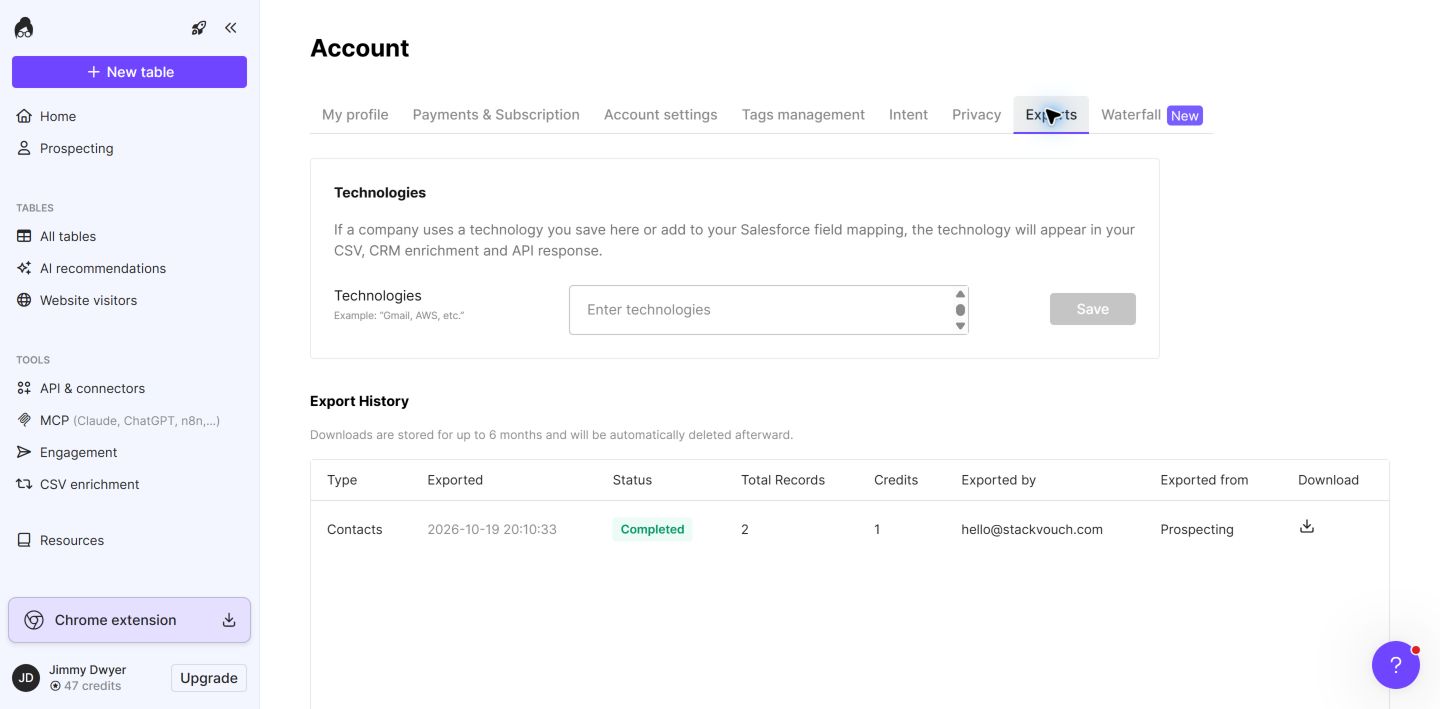
The completed job offered a download through Export History. The export was generated on October 19; we inspected the downloaded CSV on October 20.
CSV inspection, October 20: We inspected the downloaded file. It contained two data records and 56 unique, nonblank column headings. Each record had 56 fields. The file was 3,811 bytes, comma-delimited UTF-8 with a BOM, with no exact duplicate rows.
Both exported full names and their company pairings matched the fixed sample’s first two records. Both work email values matched the saved table, including their name/email pairings. Both contact-country fields were United States. The Date field read October 19 on both records; we inspected the downloaded file on October 20.
| Exported field | Observed contents across two records |
|---|---|
| Work Email | Two populated, distinct values, matching the saved table |
| Work Email Confidence | A+ on both records, a Lusha classification |
| Direct Email and Additional Email 1/2 | Blank on both records |
| Phone 1 | Two masked values, not complete phone numbers |
| Phone 1 Type | Mobile on both records; this label did not reveal the masked number |
| Job Title, Company Name and LinkedIn URL | Populated on both records; no independent current-role or company-fit audit |
These checks confirmed that the CSV preserved the two recorded contacts and their email pairings. They do not independently verify ownership, current employment or deliverability. A+ is the supplier’s exported confidence label, not a StackVouch accuracy result. We retained the raw CSV privately and publish only aggregate checks.
Engage: initial loading problem, then a saved email step
Engage displayed “Your email isn’t connected.” We left Gmail and Outlook connection buttons untouched and chose Create from scratch.
We entered an explicitly unsent test subject. The body editor continued to show a loading spinner, its embedded editor exposed no editable body, and the email-step Save button stayed disabled. A full page reload reset the unsaved subject. We did not establish whether the cause was the account, session, embedded editor or browser environment.
Saving from the empty sequence builder produced a saved notification. On October 19, the sequence list ultimately showed two default-named scaffolds, each with 0 Emails, Incomplete and disabled inactive toggles. These remained visible on the subsequent state check. We did not establish why the flow left two scaffolds. The counter showed Emails sent today 0/50.
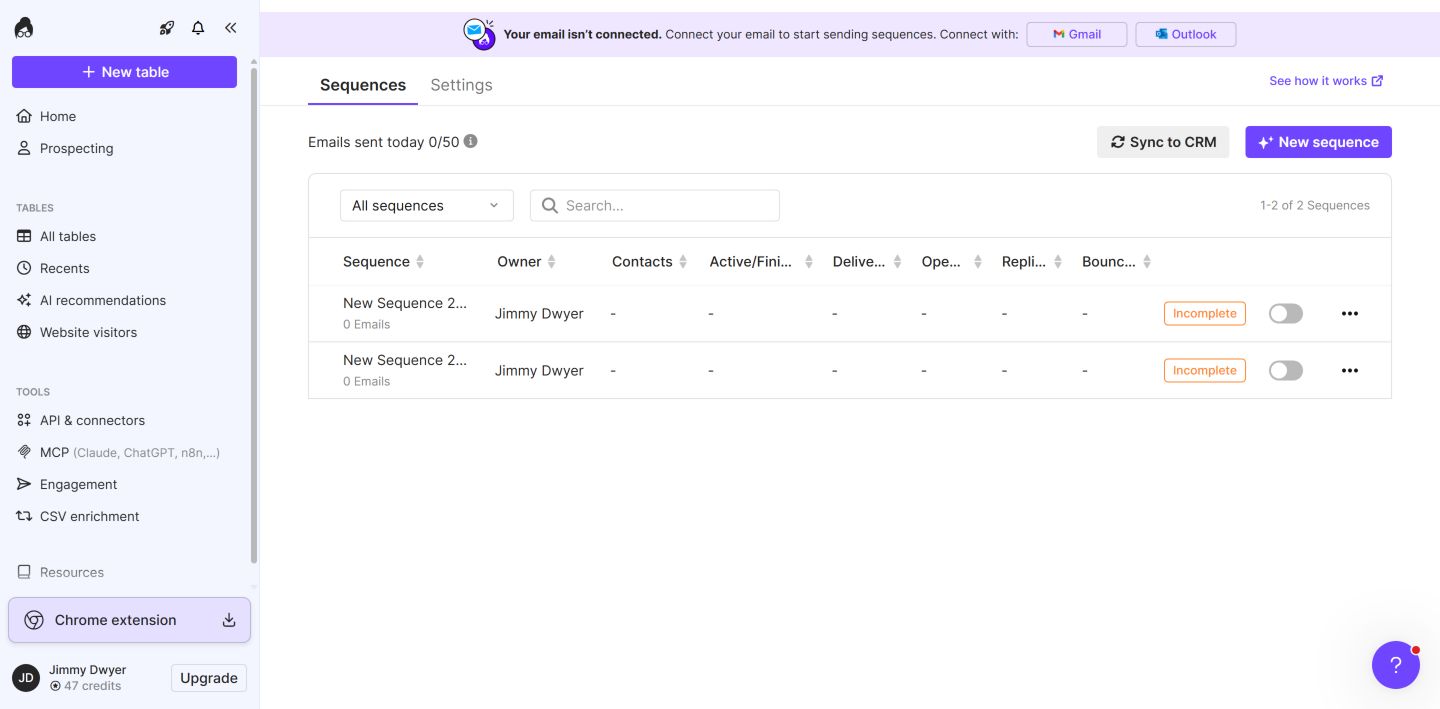
October 20 re-test: We reopened one existing scaffold through its Edit menu and chose Create from scratch. The body editor loaded normally. We entered the subject UNSENT TEST - StackVouch Lusha - 2026-10-20 and a short body explicitly instructing that the draft was for persistence testing only. We clicked Save, then reloaded the sequence page. Both the exact subject and body remained visible. The page still showed Incomplete, This sequence has not been launched yet and Your email isn’t connected. Available credits remained 47.
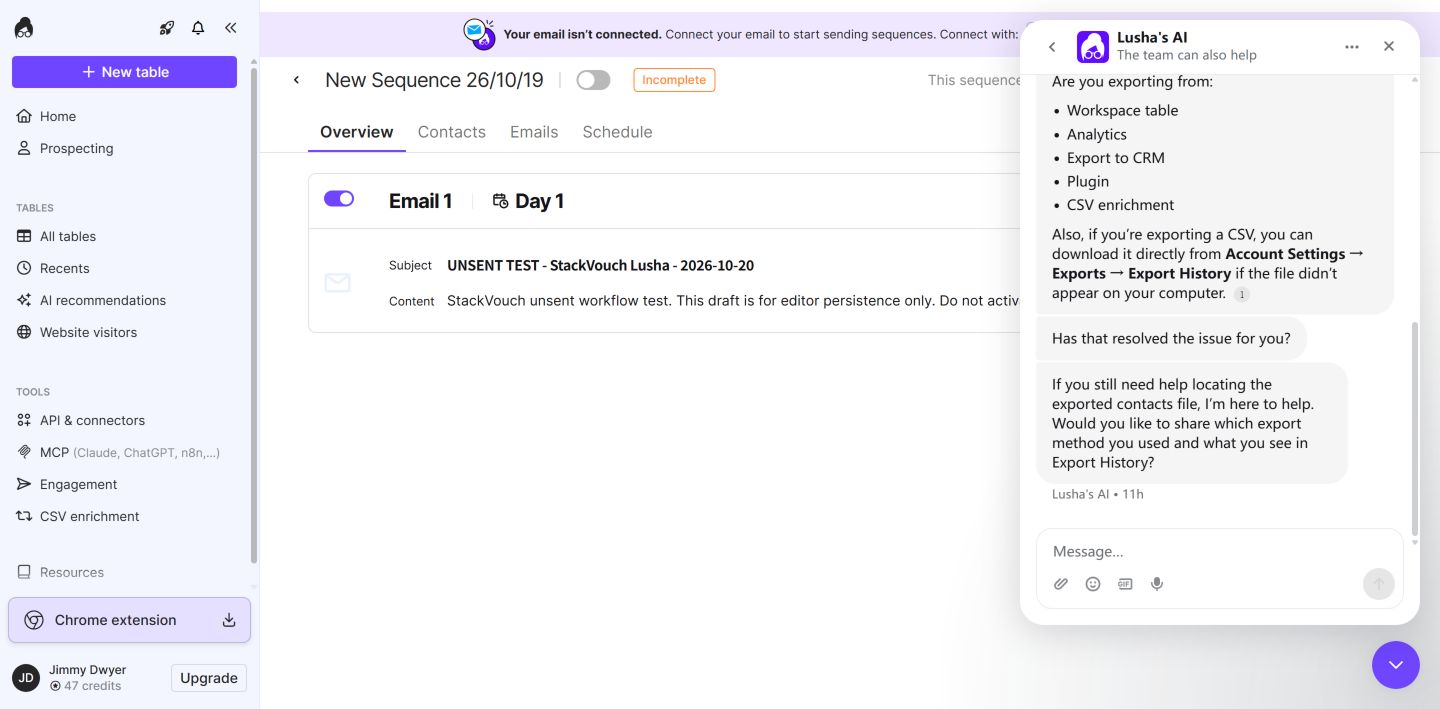
The re-test demonstrates one saved email step and its persistence without connecting a mailbox. It resolves the earlier inability to edit in this session, but does not diagnose the loading problem. The overview labeled the step Day 1 Automatically; we did not change or validate its execution timing. Personalization, a multi-step sequence and delivery remain untested. We did not activate either sequence or enroll contacts.
USD pricing observed during this session
The official pricing page, opened from this account on October 19, displayed USD. We recorded the initial yearly setting and then switched to Pay monthly, without changing credit sliders or seat inputs.
| Plan and displayed configuration | Pay monthly | Monthly figure with Pay yearly selected | Included seats | Monthly / yearly credit allocation |
|---|---|---|---|---|
| Free | $0 | — | 1 | 40/month |
| Starter | $49.90 | $37.45 | 1 | 400/month or 4,800/year |
| Pro | $69.90 | $52.45 | 2 | 600/month or 7,200/year |
| Premium | $399.90 | $299.95 | 5 | 3,400/month or 40,800/year |
| Scale | Custom | Custom | Custom | Custom |
These are the displayed package configurations. Do not multiply every price by the included seat count or assume that every figure is a per-seat rate. Yearly allocations were described as granted upfront. The monthly figures shown under yearly billing are not monthly-payment offers. We did not open paid checkout or verify taxes, a final invoice, renewal terms or other regional prices.
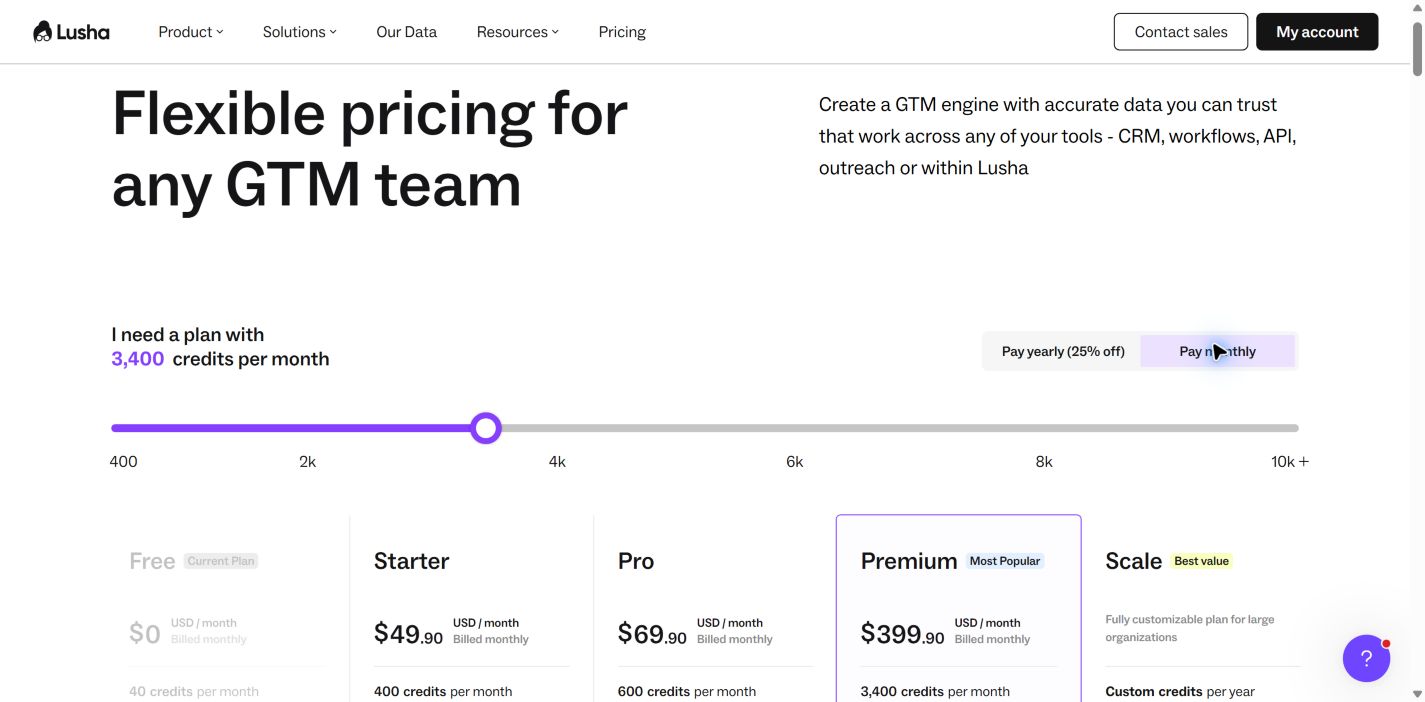
The public Free allowance was 40 credits per month. Our account’s later 50-credit allocation is a separate observation, with an unresolved cause.
What the findings change in our review
The Free plan demonstrated email retrieval and a usable two-record table handoff, including an exact repeat without extra rows. However, eight of our fixed ten results were inaccessible on this plan. A buyer should test their own target locations before treating the headline free credit allowance as accessible contact capacity.
Budget export usage as well as reveals: this two-record job incurred an additional credit. Check that your preferred save route works, since creating a table from Prospecting failed while creating a separate table and adding existing contacts succeeded.
Engage’s body editor worked on the October 20 re-test, and one email’s subject and body survived reload without a mailbox connection. That supports basic draft preparation; it does not establish reliable scheduling or delivery. The inspected CSV also supports a two-record handoff with the recorded email pairs intact. The masked phone fields and A+ confidence labels need to remain distinct from retrieved phone numbers and independent email verification.
Limits and remaining checks
- One newly registered Free account and one fixed ten-result convenience sample. Paid-plan access, other countries, other industries and larger batches were not tested.
- Two displayed email values; no independent ownership, role, company-fit or deliverability assessment.
- No phone reveal, extension workflow, API, CRM sync, CSV enrichment, AI query or mailbox connection.
- Two-record CSV structure and recorded name/company and name/email pairings verified. No downstream CRM import or independent data-accuracy check.
- One exact repeat within one table; no broad duplicate-quality claim.
- One saved email step verified on October 20; no sequence timing, personalization, multi-step execution or delivery test. Zero outreach sent.
- The allocation increase, paid-plan gate rationale, table-creation error and body-editor loading cause remain unresolved.
Re-test and correction history
| Date | Record |
|---|---|
| October 19, 2026 | Original Free-plan workflow test: ten fixed results, two email values, eight access gates, three credits used, a two-record named table, one exact repeated addition and a completed export job. At this checkpoint, the export job was complete but the downloaded file had not yet been inspected. Engage inspection left only empty, inactive scaffolds; no outreach was sent. |
| October 20, 2026 | Reopened an existing Engage scaffold. The body editor loaded, and a saved email’s subject and body persisted after reload. The sequence stayed incomplete and unlaunched, with no connected mailbox and 47 credits available. No new contacts were revealed or outreach sent. |
| October 20, 2026 — CSV inspection | Inspected the downloaded CSV: two records, 56 unique columns, matched name/company and name/email pairs, two A+ supplier labels and masked phone values. No new contact reveal or export job was needed for these file checks. |
| October 20, 2026 — Editorial revision | Condensed the export and inspection account around the test dates and results, and removed an incorrectly selected new-table illustration. Original observations, sample, credits and test limits are unchanged; no new product test was performed. |